At 40, Silverthorne heads over the hill
ALL |
SILVERTHORNE – When Silverthorne officially became a town 40 years ago today, it ran on a meager $10,000 annual budget and consisted of a few houses and some trailer parks. Highway 9 was paved, but the few roads in town were dirt and the first traffic light was still a decade away. A smattering of businesses lined Dillon Avenue, which ran parallel to Highway 9, like the Old Dillon Inn, The Mint and the Wildwood Bar – now the Elks Lodge – all buildings that had been moved when Old Dillon was flooded to create the reservoir. Back then, it was community of no more than 100 people, mostly ranchers and men who worked at the Climax mine near Leadville or on the construction of the Dillon Dam. “I don’t believe anybody had that much money up here. There were just a lot of hardworking people. … There was no reason not to be here – there were no drugs, there were no crimes,” said Glenda Hill, whose father-in-law Clayton owned the Silverthorne Ranch, the land on which the town was built.Over the past four decades, the county’s youngest town has transformed from a sprawling ranching community into a bustling service center with sales tax dollars bankrolling park and river improvements and ranchland giving way to neighborhoods.
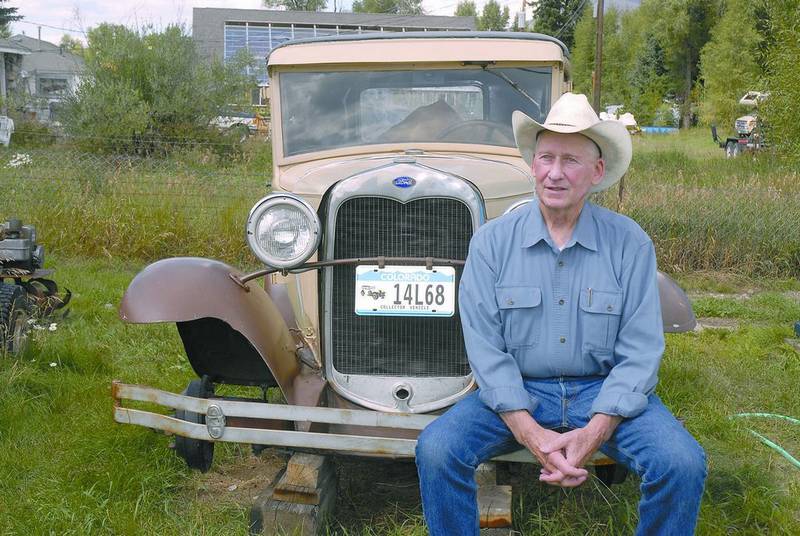
Clayton Hill moved to Colorado in 1929 and homesteaded numerous ranches on the Blue River. He acquired the Silverthorne Ranch and ran it for about a decade before building 14 houses – called the Buffalo subdivision – on the east side of the river when the Dillon Dam was under construction. The one-story, bungalow-style homes sat in a row that stretched from where the Silverthorne Pavilion is now down to 12th Street.Hill sold some of the homes in the early 1960s for $8,500 a piece. Those he rented out went for $65 per month.”Times were tough and money was scarce,” Hill said. “Some thought Clayton was a rough-and-gruff, but he never evicted anyone.”Hill remembers the day Silverthorne became incorporated on Sept. 5, 1967.The folks in town voted to call the area Silverthorne instead of Dillon, which was under consideration because of the three buildings that had been moved from Old Dillon.”(Clayton) come home and he had his hands in his pockets and he was really tickled they were gonna call it Silverthorne and not Dillon. I don’t know why,” she said.Norm Cripps was appointed mayor until the following April when the next official town election was scheduled.That’s when Warren Alloway won the town’s top post.”When I was elected in ’68, I think there were 40 eligible voters,” Alloway said from the back yard of his home on the Blue River, where he’s lived for 43 years.There was no town hall, school or fire station and the brand new town survived on a budget of $10,000 collected mostly from a small property tax.One of the first orders of business under Alloway’s leadership was to construct a town hall so the council would have a proper place to meet.A contractor at the Eisenhower Tunnel donated concrete and Alloway, the town council and a few citizens worked for 12 hours straight to build a 40′ by 60′ room on 4th Street where the Summit Stage station is now located.”I was kind of proud of that because it was like old-fashioned stuff where all the neighbors pull together and get something done,” Alloway said.The building, which stood for about 14 years before the existing town hall was constructed, was used as a meeting hall and as storage for a fire truck.In 1972, Silverthorne landed a grant to form the joint sewer authority, increasing the capacity for water and sewer taps in town, and a couple years later citizens voted in a sales tax.With the groundwork laid for future development, Silverthorne was poised for growth.
By the early 1980s, about 1,500 people lived in town. The Summit Place shopping center with City Market as an anchor was the primary moneymaker.Trailer parks continued to be an affordable means of living in town, the Beaver Valley and Arctic Placer subdivisions were built as well as the Rainbow Village condos, and homes in Willowbrook were quickly sprouting up.”It was growing then and anything that’s growing starts making new demands,” said Tom Long, Silverthorne’s mayor from the late 1980s until he was elected to the county commission in 1998. When Long came on board, the council began searching for an economic boost. With the unpopularity among citizens of a property tax, they focused on attracting a sales-tax oriented business to support growth.About that time, the Department of Local Affairs talked to the to council about the increasing popularity of the factory store business model on the East Coast and suggested the town seek out that sort of development.”I’ve always said I’d sooner be lucky than good and about a month later a man named Don Glen walked into the town hall and said, ‘Hey, we’d like to talk to you about putting in some factory stores.’ So we began that discussion and about a year later we had Phase 1 over here going in the ground,” Long said.Phases 2 and 3 followed and the Silverthorne Factory Stores soon became an important sales tax revenue generator for the town.But, the town was also experiencing some growing pains.It had gained the nickname “Trailerthorne” and many of the older Buffalo subdivision homes sat unevenly on rocks instead of on legitimate foundations. Silverthorne’s image needed some polishing.The town started an annual car round-up to clear out some of the junk automobiles around town. It rented a hydraulic car crusher and any vehicle without active tags or that didn’t run “went on the hook,” Long said.The event, though no longer around in its original form, is now known as the town’s annual clean-up day.Silverthorne also addressed the problems in its numerous trailer parks with an amortization program. Park owners either had to bring their properties up to certain standards, such as planting grass and paving parking areas, or leave.
“In one trailer (we) found a garden hose with radiator clamps on it running from the gas meter to the trailer,” Long said. “(There were) life safety issues.”Many people walked away from the parks and today just two of the eight trailer parks remain in Silverthorne.One by one, the town purchased the cluster of 1960s homes positioned where the Pavilion is with a vision of creating a town center one day.Highway 9 expanded from two lanes to four lanes. The town acquired the land for the recreation center from the Town of Dillon at no cost, but forgave a chunk of sales tax money the state remitted to Dillon instead of Silverthorne. The work-out facility opened in 1994.”We were literally at that point in time trying to pull this town up by its boot straps,” Long said. But, while Silverthorne was in the midst of a major facelift, it suffered a significant setback.
In 1997, City Market moved to Dillon delivering a $1 million blow to Silverthorne’s annual revenue. Jobs were cut, employees went without raises, services were trimmed and, in 1999, the town set out to attract another source of income.That came in the form of Target, which opened in Silverthorne in 2003 with virtually no opposition, said then-mayor Lou DelPiccolo.Target purchased most of the land for its store from the owner of one of the trailer parks that didn’t adhere to Long’s amortization program.Along with increasing town revenues, “Target became a catalyst in eliminating one of the big eyesore and public health issues” in town, DelPiccolo said.With its financial hardships in the past, much of Silverthorne’s focus in more recent years has been on enhancing its parks and trails, as well as developing a town center around the Silverthorne Pavilion, which opened in 2001.Silverthorne has connected to the countywide recreation path system, opened the skate park and built the North Pond Park.Without a Main Street where people could mingle, the council felt offering public open spaces was a way to create a sense of community, DelPiccolo said. Today, Silverthorne has a year-round population of about 3,000.





Support Local Journalism
Support Local Journalism
As a Summit Daily News reader, you make our work possible.
Summit Daily is embarking on a multiyear project to digitize its archives going back to 1989 and make them available to the public in partnership with the Colorado Historic Newspapers Collection. The full project is expected to cost about $165,000. All donations made in 2023 will go directly toward this project.
Every contribution, no matter the size, will make a difference.