Weather cancels men’s super-G at worlds
Chris Freud Follow
Justin Q. McCarty |
BEAVER CREEK — The decision came quickly on Wednesday morning.
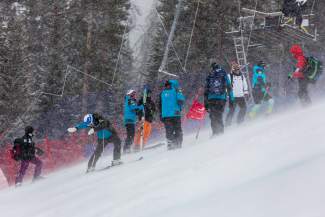
With snow dumping and the wind blowing, the International Ski Federation made a quick call at 10 a.m., postponing Wednesday’s FIS Alpine World Ski Championship men’s super-G at Beaver Creek.
Ninety minutes after the postponement, FIS announced by text that the super-G was rescheduled for Thursday at 11 a.m., to be followed by women’s downhill training at 1:30 p.m. Thursday was already a reserve day for the championships with just men’s and women’s downhill training originally scheduled.
What’s more, the weather report looks much better for Thursday with weather.com calling for temperatures in the low 40s with zero percent chance of precipitation and mostly sunny skies.
While the weather report, of course, is not set in stone as gospel truth, the meteorologists got it right on Wednesday. The National Weather Service issued a winter storm advisory, starting on Tuesday at 6 p.m., extending through the end of Wednesday at midnight.
The advisory became a winter storm watch by Wednesday and the snow started falling. The National Weather Service estimated that 6-10 inches were to fall on Wednesday. A news release from the Vail Valley Foundation said that snow was falling at a rate of two inches per hour at the time of the postponement.
Too Much Snow?
While the concept of snow, of course, is a necessity for ski racing, there is the paradox of needing a base upon which to ski, and, at the same time, safety. The snow for the ski-racing world is different than resort snow, such as the powder for which Colorado is known.
The snow on both the women’s Raptor and men’s Birds of Prey racecourses is injected with water to make it as fast as possible. Accumulations of snow on the course make it slower and hazardous for racers, despite the work of the Talon crew, whose mission is to care for the courses by shoveling and/or slipping them, and doing whatever else is necessary.
Through the years, the Talon group, and Beaver Creek race crew, have received rave reviews from racers of all nationalities for its work, but the crew can only do so much to keep up with Mother Nature.
Then there’s visibility, particularly for the speed events like the super-G, the downhills on Friday and Saturday and the downhill potions of the combineds on Sunday and Monday.
Racers can reach speeds of 70 mph in downhill and 60 mph in super-G. With the wind blowing the sideways at times on Wednesday, that made for unsafe racing conditions.
IT HAPPENS
The world championships’ schedule is built with weather postponements in mind. Thursday was already scheduled as a day with no official competition. Next Wednesday is also a reserve day, should weather interfere with the downhills and the combineds.
When Vail and Beaver Creek hosted Worlds in 1999, the women’s super-G, the first event of the competition, was snowed out. That made the men’s super-G the opening event with Hermann Maier and Lasse Kjus tying down to the hundredth of a second for the only gold-medal tie in worlds history.
That snow also had no hope of slowing down the Austrians in 1999. Two days after the postponement, Alexandra Meissnitzer, Renate Goetschl and Michaela Dorfmeister swept the podium, the first 1-2-3 finish by one nation in women’s worlds competition.
More recently, both the 2013 worlds in Schladming, Austria, and the 2011 edition in Garmisch, Germany, both had races rescheduled.
The last time worlds did not hold an individual discipline title event (super-G) was 1993 in Morioka, Japan.
In other logistics, the men’s downhill training scheduled for Thursday has been canceled.
They already had a training session on Tuesday and will have another one slated for Friday before Saturday’s race.






Support Local Journalism
Support Local Journalism
As a Summit Daily News reader, you make our work possible.
Summit Daily is embarking on a multiyear project to digitize its archives going back to 1989 and make them available to the public in partnership with the Colorado Historic Newspapers Collection. The full project is expected to cost about $165,000. All donations made in 2023 will go directly toward this project.
Every contribution, no matter the size, will make a difference.