Colorado lawmakers floated 3 ways to curb or halt taxpayer spending on wolves. Here’s the one advancing.
The Joint Budget Committee rejected amendments aimed at putting “women over wolves” and reducing the wolf allocation by 13%

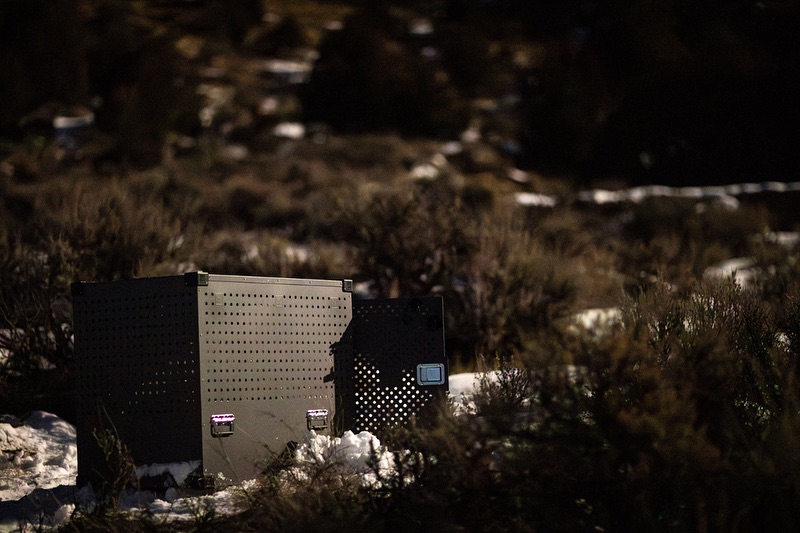
Colorado Parks and Wildlife/Courtesy Photo
As Colorado lawmakers work through the budget for 2026-27, how the state is spending money on its gray wolf reintroduction effort has been a topic of much debate.
Legislators passed three amendments — one in the House and two in the Senate — about wolf-related spending, with the Joint Budget Committee ultimately deciding which will make it into the final budget.
On Thursday, April 23, the committee chose to move forward with the House amendment, which would ask Colorado Parks and Wildlife not to spend any general fund dollars to relocate more wolves to the state. It was introduced by Rep. Ty Winter, R-Trinidad, and Rep. Meghan Lukens, D-Steamboat Springs.
Colorado Parks and Wildlife receives $2.1 million annually from the state general fund to run the wolf reintroduction program, which was mandated by voters in 2020. The House amendment would not change this allocation, but rather gives direction on how it should be spent.
Under this direction from lawmakers, the state wildlife agency could still use gifts, grants and donations to pay for new wolves for the state’s reintroduction. The Joint Budget Committee made one edit to the House’s footnote that would allow Parks and Wildlife to also use non-license revenue from its wildlife cash fund on new wolves.
“What I would like to say to my ranchers is that we are not using their taxpayer dollars to introduce more wolves into their backyard,” Lukens said when introducing the amendment.
After the committee makes its final adjustments to the budget bill this week, it will face one more vote from the House and Senate before heading to Gov. Jared Polis’s desk.
Committee rejects ‘women over wolves’ and budget reduction options
The committee chose to move forward with this amendment over two others that passed in the Senate.
One — introduced by Sens. Dylan Roberts, D-Frisco, and Marc Catlin, R-Montrose — was similar in intent to the House amendment, but also proposed reducing the general fund allocation for wolves by $272,867, an amount commensurate with the amount Parks and Wildlife spent in 2025 to bring 15 wolves from British Columbia to Colorado.
“Those wolves and the impacts of them have already cost state taxpayers far more than they thought it was going to cost when they voted on this in 2020,” Roberts said when introducing the amendment. “The Blue Book in 2020 said it was gonna cost $800,000 a year. Now, the costs far exceed $3 million per year when you add the cost of new wolves, mitigation efforts and compensation to livestock owners for their losses.”
Roberts framed this expense within the state’s current budget situation, where lawmakers need to make large cuts to close a $1.5 billion shortfall.
“We are still obviously in very tough budget times, and we don’t believe that in this time of cutting health care for sick children, money for transportation projects across the state (and) difficult times for education funding that the general fund should be used for buying new wolves and transporting them to Colorado,” Roberts said.
Catlin emphasized that this amendment would have left general fund dollars for the state to continue funding projects to minimize conflict between wolves and ranchers, to compensate ranchers for losses and to manage the wolves.
“This goes directly to the people that are out there, that run cattle, that run sheep, they’re running livestock out in the mountains and in the High Country,” Catlin said. “This allows them to continue, to practice the items that we’ve asked them to do, and they’re trying their best. But it does stop us putting another bunch of troublesome animals back into the environment that they’re still trying to manage.”
The amendment mirrored a bill sponsored by both Roberts and Catlin that passed during an August special session convened to address budget challenges last year. It redirected $264,268 of the $2.1 million allocated in the 2025-26 budget for the wolf program to Colorado’s Health Insurance Affordability Enterprise and also barred Parks and Wildlife from using the remaining general fund dollars to bring in new wolves during the fiscal year.
The second amendment that did not move forward was introduced by Sen. Larry Liston, R-Colorado Springs, as the “WOW” or “women over wolves” amendment. It proposed reallocating the entire $2.1 million budgeted for wolves to the Colorado Department of Health Care Policy and Financing. Liston said the purpose was to reduce obstetrical care rates for women and children, “especially in the rural areas.”
“We’re going to put women over wolves,” he said, when introducing the amendment on April 14. “This is a great amendment. It still leaves money for wolves. There’s plenty of money for wolves, and it does not — I emphasize, it does not — affect the reimbursement for ranchers whose cattle may have been killed by wolves.”
Colorado lawmakers created a separate fund in 2021 to compensate ranchers for livestock losses from wolves. This fund receives an annual allocation of $350,000. Compensation for losses in 2025 are expected to exceed $1 million, which the agency can also use federal dollars and non-license revenue from its wildlife cash fund to pay.
In a December 2025 report to Colorado’s joint budget committee, Parks and Wildlife said the majority of its wolf-related expenses go toward personnel, followed by operating costs, compensation for ranchers and conflict minimization programs and tools. In the first seven months of 2025, the agency spent $3 million on the program.
These expenses were paid for from the $2.1 million general fund allocation, the $350,000 for livestock depredation, federal dollars, grants, non-license revenue and the “Born to Be Wild” wolf license plate. Sales of the license plate generated over $1 million during its first 21 months and can only be spent on tools and programs seeking to minimize wolf-livestock conflict.






Support Local Journalism
Support Local Journalism
As a Summit Daily News reader, you make our work possible.
Summit Daily is embarking on a multiyear project to digitize its archives going back to 1989 and make them available to the public in partnership with the Colorado Historic Newspapers Collection. The full project is expected to cost about $165,000. All donations made in 2023 will go directly toward this project.
Every contribution, no matter the size, will make a difference.