Colorado says it will not release more wolves this winter
The announcement comes several months after Parks and Wildlife’s plans to return to British Columbia for wolves were interrupted by changes in federal direction

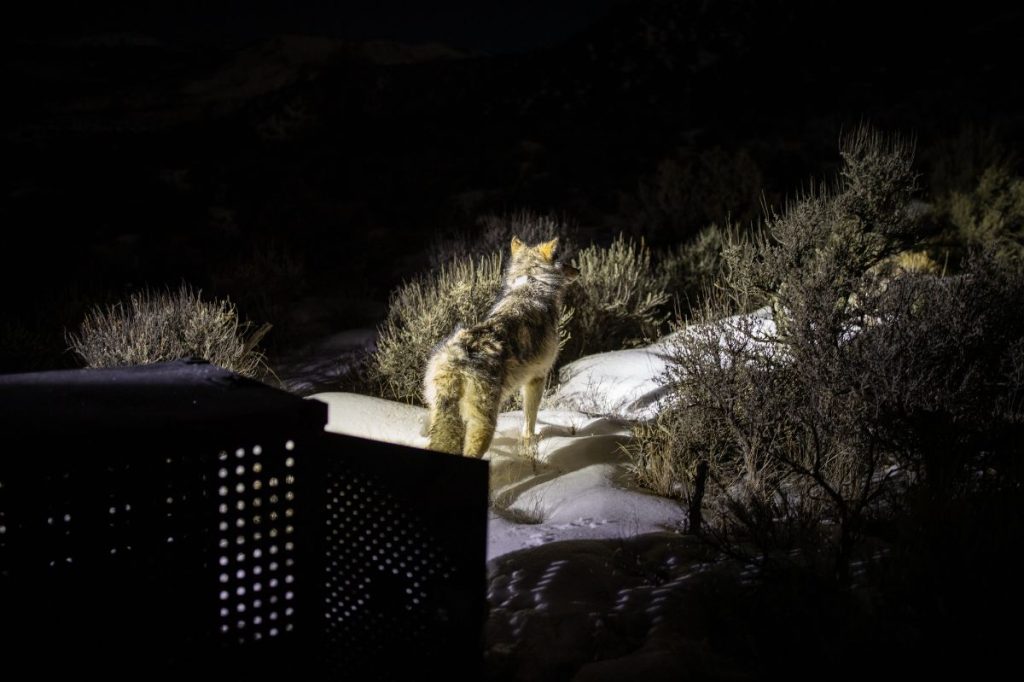
Colorado Parks and Wildlife/Courtesy Photo
Colorado Parks and Wildlife will not be releasing additional wolves this winter after failing to find a source for the third winter of the voter-mandated reintroduction program.
The state wildlife agency announced the decision on Wednesday, Jan. 21, coming just months after the U.S. Fish and Wildlife Service interrupted its plans to bring a batch of wolves from British Columbia.
Parks and Wildlife says it will continue to explore options to conduct another release next winter.
“During this intermediate time, (Colorado Parks and Wildlife) will continue to meet with producers and other stakeholders, including U.S. Fish and Wildlife Service, to explore how to maximize the restoration effort and achieve our plan of establishing a self-sustaining gray wolf population in Colorado,” said Laura Clellan, the wildlife agency’s acting director, in a news release.
Colorado’s wolf restoration plan recommends that Parks and Wildlife release between 30-50 wolves in the first three to five years of reintroduction. The agency has released 25 wolves in the first two years. The first 10 wolves, released in December 2023 in Grand and Summit counties, came from Oregon. The next 15 wolves were brought from British Columbia and released in Pitkin and Eagle counties.
While four packs have been established — and an unreported number of pups born — 11 of the 25 reintroduced wolves have died, including a mortality last week. With a pause in reintroductions at this point in the program, future reproductions and mortalities will be crucial to Parks and Wildlife successfully achieving the mandate imposed by Colorado voters in 2020.
“When populations are small, the contributions of each individual is especially significant,” said Eric Odell, Colorado Parks and Wildlife’s wolf program manager, in the news release, mirroring comments made by Clellan to the agency’s commission last week.
“It is not possible to predict the impact of foregoing a third year of translocations without knowing what may occur in the coming year,” Odell added. “If mortality remains high, as observed in 2025, the risk of failing to achieve a self-sustaining wolf population in Colorado increases, potentially requiring additional resources to address.”
Parks and Wildlife had planned to return to British Columbia this winter, signing an agreement with the province to capture up to 15 wolves. However, new leadership and direction from the U.S. Fish and Wildlife Service forced the state wildlife agency to look to Northern Rockies states instead.
Brian Nesvik, the newly-appointed director of the Fish and Wildlife Service, sent a letter to Parks and Wildlife in October, claiming that Colorado could only source wolves from northern Rockies states where gray wolves are not listed as endangered. This includes Idaho, Montana, Wyoming, and portions of Oregon, Washington and Utah. Nesvik argued that sourcing wolves from outside of this region violated the 10(j) agreement, reversing the approval granted by the federal agency prior to Nesvik’s appointment.
With the change in direction, Parks and Wildlife attempted to find a source of wolves within Nesvik’s parameters for this winter. Montana, Idaho and Wyoming all declined to provide wolves in 2023. Idaho declined again this winter, as did Washington when Parks and Wildlife made the request to the northwest state’s wildlife commission in November.
As recently as last week, Parks and Wildlife officials maintained that the agency was still working to find a source from eligible states and tribal nations. However, the agency was facing a closing window. At a Jan. 8 northwest region sportspersons caucus meeting, Travis Black, the agency’s northwest regional manager, said that with February bringing the start of wolf breeding season, the biological window for captures and releases was approaching.
Rob Edward, co-founder of the Rocky Mountain Wolf Project, which led the citizen effort to reintroduce wolves, said the news was not surprising due to the political meddling at play.
“My basic take is that you have the agency in charge of recovering threatened and endangered species meddling with a state program to recover endangered species to the point where the agency can’t do what is biologically necessary to advance the program,” Edward said.
Kaitie Schneider, the Colorado wolf representative for the national wildlife advocacy organization, Defenders of Wildlife, said that Defenders was “beyond disappointed that the Trump administration is using its political might to not only block (Parks and Wildlife’s) efforts to release wolves this winter but also to thwart the will of Coloradans who voted for this historic reintroduction program.”
“Building a self-sustaining population requires consistent efforts over multiple years, and the current population remains vulnerable,” she added. “Every year matters, and any delay extends the timeline for reaching that goal.”
Edward said that Colorado’s wolf population is new, small and lacks the genetic diversity to ensure long-term success of the species in Colorado. However, while “Fish and Wildlife Service’s meddling has shut the motor down” on Colorado’s plan for this winter’s release, Edward said it is “not the end of the story.”
“Failure — which is what the ag industry seems to want — is not an option. Success is the law,” he said. “We will get past this, and we will get more wolves on the ground as soon as we can.”
Will a pause be constructive?
Colorado’s announcement that it will not release any additional wolves this winter was one that came with relief from agricultural producers, lawmakers and Western Slope communities that have continued to lobby for a pause in the wolf reintroduction.
“We’ve been asking for a pause for over a year now,” said Tim Ritschard, a Grand County rancher and president of Middle Park Stockgrowers.
Sen. Dylan Roberts, D-Frisco, has been a part of several legislative-led efforts to pause the wolf program, including a bill before the first wolves were reintroduced that was ultimately vetoed by Gov. Jared Polis and a special session in August that redirected funds for wolf releases, and originally sought a one-year pause.
“This is what we’ve been asking for, just some more time,” Roberts said on Wednesday. “I, of course, would have preferred more time before the first wolves got here … but we wanted to give more time for folks to deal with the wolves that are here and get mitigation resources in place before any wolves came.”
“I know this was not a deliberate pause by the agency, but it’s going to have the same effect and now this is an opportunity to correct some of the mistakes that have been made in the past and hopefully improve things, even if slightly, before any wolves come in future years,” Roberts added.
Sen. Marc Catlin, R-Montrose, said that he heard Wednesday from many constituents in the southwest region where Parks and Wildlife had planned to release the next wolves.
“A lot of my producers in Gunnison, Montrose and Delta were really concerned,” Catin said. “They didn’t know what to expect, they were just kind of waiting. I spoke with some producers over there (today); they were relieved.”
Catlin said that he was glad no more wolves would be introduced in the district this winter.
“This is good for the producers in Colorado that it’s not stopping the program, it’s simply saying, ‘well we can’t find the wolves,'” he said. “It gives us an opportunity to get ready.”
The Colorado Cattleman’s Association was among the 29 agricultural groups, hunting organizations and county commissioners that signed a petition in September requesting a one-year pause from Parks and Wildlife. The petition cited concerns about rising costs, livestock losses, and a feeling of unpreparedness to deal with wolves on the ground from some communities and producers.
In a statement on Wednesday, the association said that Parks and Wildlife’s decision not to release more wolves is a “constructive step that reflects the need for the state to pause and address the ongoing concerns raised by livestock producers and rural communities.”
“A pause in releases must not mean a pause in action,” said Curt Russell, president of the Colorado Cattlemen’s Association, in a news release. “Producers are living with wolves today, and effective management tools, compensation and responsiveness from the state are critical during this period.”
In its news release, Parks and Wildlife reported that the agency will “continue to work with producers to implement the tactics outlined in the Wolf-Livestock Conflict Minimization Program Guide and build on significant conflict mitigation milestones” in 2025.
The milestones, it adds, include its range rider program, hiring a wolf damage and conflict minimization manager, bringing in additional staff to support with wolf depredation investigations, expanding the agency’s hard tool stockpile of items to deter wolves, completing site assessments and more.
Colorado Cattleman’s Association urged the state to focus on “practical, producer-driven solutions” during this pause in releases. These solutions, it adds, include “clear and workable lethal take authority when livestock are threatened or attacked,” timely and fair compensation and continued work with producers to “address conflicts, management gaps and on-the-ground realities.”
“Hopefully, with this pause, we can get these programs caught up to where they should be,” Ritschard said. adding that this includes better guidance on carcass management and a “sustainable” range rider program. “This pause will allow (the Colorado Department of Agriculture), (Parks and Wildlife), landowners and producers to focus on what wolves are in Colorado, so we can find what non-lethal tools fit their operation and landscape.
Chance Jenkins, a Garfield County rancher and president of the Holy Cross Stockgrowers Association, said he hoped the pause would result in the state continuing to grow the range riding program, finding funding to continue it in the long term, as well as taking the time to recognize patterns, determine what mitigation tools work and follow through on “what they said they would do.”
“I’m glad for whatever reason that it’s paused,” Jenkins said. “At the end of the day, they are living, breathing animals, and I’m not a big fan of seeing almost half of a population die due to mismanagement.”
Schneider, who has been working directly with Colorado producers on projects to reduce conflict between wolves and livestock, said she’s already started to see increasing engagement from communities, showing that there is a way for both wolves, producers and livestock to thrive in Colorado.
“The reintroduction program is on a path for success; it just needs the runway to do so,” Schneider said. “We at Defenders urge all stakeholders to make productive use of this year to enhance preparedness, implement livestock protection approaches, and continue to build the collaborative partnerships needed to foster long-term success.”
Catlin said he believes that the temporary pause will be beneficial for relationships between Parks and Wildlife and landowners.
“Now we don’t have the pressure, so we can see collaboration start to bloom again,” he said. “No matter how it came about, this is what the producers were after … I’m hopeful that this will help with a lot of the sore feelings and people who were worried about what was going to happen to their outfits.”
Robert Tann contributed to this report.



Support Local Journalism
Support Local Journalism
As a Summit Daily News reader, you make our work possible.
Summit Daily is embarking on a multiyear project to digitize its archives going back to 1989 and make them available to the public in partnership with the Colorado Historic Newspapers Collection. The full project is expected to cost about $165,000. All donations made in 2023 will go directly toward this project.
Every contribution, no matter the size, will make a difference.