‘Better safe than sorry’: Colorado mountain utility providers ask residents to prepare for potential power outages as wildfire risk ramps up
Xcel Energy, Mountain Parks Electric Inc., Holy Cross Electric Association and Yampa Valley Electric Association could implement Public Safety Power Shutoffs if wildfire risk is elevated

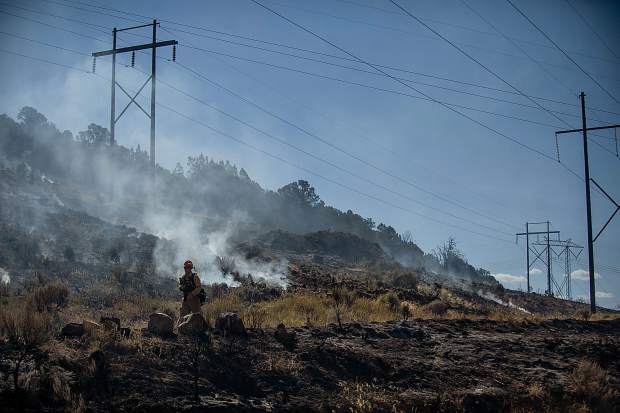
The Aspen Times archives
Utility providers in the Colorado mountains are planning to use a host of tools — including potential power shutoffs — to reduce wildfire risk this summer as the state faces widespread drought conditions.
While power shutoffs are a last resort, Western Slope utility providers say mountain residents should be prepared for the possibility, especially during extreme fire weather when hot, dry conditions are met with high winds.
“It’s not lost on us that these steps can create some challenges for our customers, but we only use them when they’re absolutely necessary,” said Brad McCloud, Xcel Energy’s community relations manager for the Western Slope. “It’s to protect public safety and reduce the possibility of wildfires. In the end, most of us agree — it’s better to be safe than sorry.”
Colorado is entering the summer season after a winter with a record-low snowpack. The lack of snow has fueled severe drought conditions across the state and concerns that the wildfire risk could be especially high this summer. The latest models from the National Interagency Fire Center show the Western Slope could see an above-normal risk of wildfires in June, July and August.
Some of the largest and most devastating wildfires in the West have been sparked by utility infrastructure, such as aging electrical equipment or downed power lines that come into contact with dry vegetation during high winds. The Marshall Fire that killed two people and destroyed over 1,000 homes in Boulder County, for example, was likely sparked by damaged power lines during a high-wind event in 2021.
Xcel Energy, Mountain Parks Electric Inc., Holy Cross Electric Association and Yampa Valley Electric Association have all published wildfire mitigation plans that include what are known as Public Safety Power Shutoffs. This type of power shutoff is a pro-active decision that a utility provider can make to shut off power in order to prevent the possibility of electric infrastructure sparking a wildfire when conditions are especially extreme.
When wildfire risk is high, Colorado utility companies and cooperatives can also implement what are often known as Enhanced Powerline Safety Settings to more quickly de-energize power lines that come into contact with an object, such as a fallen tree. These sensitive settings can lead to unplanned outages that can sometimes last for an extended period, due to the need to inspect the lines before re-energizing them, according to emails and interviews with utility providers.
With the wildfire season ramping up, residents should ensure that they are signed up to receive alerts from their local utility provider and emergency services. Utility providers also recommend that residents check that their accounts are up-to-date, including any information about medical needs that could be impacted by outages. It is also recommended to have an emergency kit ready with flashlights and other necessities in case of an extended outage.
“I know how challenging and frustrating power outages can be,” Mountain Park Electric CEO Virginia Harman said in a statement. “However, … our obligation to ensure the safety of our community and the long-term reliability of our system outweighs convenience. That’s why I ask you all to have patience with us this summer as we operate our system with wildfire prevention as our top priority.”
Public Safety Power Shutoffs
Utility providers said that Public Safety Power Shutoffs are only used in the most extreme cases and power companies and cooperatives said that they will always provide as much heads-up as possible ahead of a Public Safety Power Shutoff.
“We do not take any of this lightly and we understand that our job is to keep the lights on,” Holy Cross Electric Association President and CEO Bryan Hannegan said in an email, “but we will only do so in a safe and thoughtful manner that protects our members, our employees and our communities.”
Public Safety Power Shutoffs are only used when all other wildfire mitigation measures have been exhausted and it is “simply unsafe” to continue operating the electrical system, Hannegan said. He noted that decisions about Public Safety Power Shutoff are often made in coordination with local emergency managers.
Utility providers are also constantly monitoring conditions — including wind speeds, relative humidity, fuel moisture and temperature — to understand the current wildfire risk and what measures are necessary, McCloud said. Shutoffs could last from several hours to up to a day or two, depending on the fire risk, he said.
The Yampa Valley Electric Association — which covers Craig, Hayden, Steamboat Springs and the surrounding area — implemented a Public Safety Power Shutoff for the west side of Steamboat in January, due to a major windstorm. The association also enacted planned power shutoffs on three occasions last summer due to active wildfires near Elkhead Reservoir, within the city of Craig and in Elk Springs.
Xcel Energy — which is Colorado’s largest utility company with 1.6 million energy customers — has also used Public Safety Power Shutoffs in recent months during high-wind events along the Front Range.
Enhanced Powerline Safety Setting
Across the mountains, utility providers are planning to implement Enhanced Powerline Safety Settings that make power lines more sensitive anytime wildfire risk is elevated. The Holy Cross Electric Association refers to these more sensitive settings as “fire settings,” while the Yampa Valley Electric Association refers to them as “fire protection mode.”
If the National Weather Service issues a “red flag warning” due to high winds and dry conditions, McCloud said utility providers have probably activated Enhanced Powerline Safety Settings to reduce the risk of power lines sparking a fire.
The safety settings mean that if an object — such as a downed tree or branch or an animal like a bird or a squirrel — comes in contact with a power line, it will automatically de-energize so as not to spark. Before re-energizing the lines, utility providers said they have to ensure that there is no remaining debris that could catch fire, often requiring a manual inspection that can result in longer outages.





Support Local Journalism
Support Local Journalism
As a Summit Daily News reader, you make our work possible.
Summit Daily is embarking on a multiyear project to digitize its archives going back to 1989 and make them available to the public in partnership with the Colorado Historic Newspapers Collection. The full project is expected to cost about $165,000. All donations made in 2023 will go directly toward this project.
Every contribution, no matter the size, will make a difference.