STEM takes root in Summit County
summit daily news
ALL |
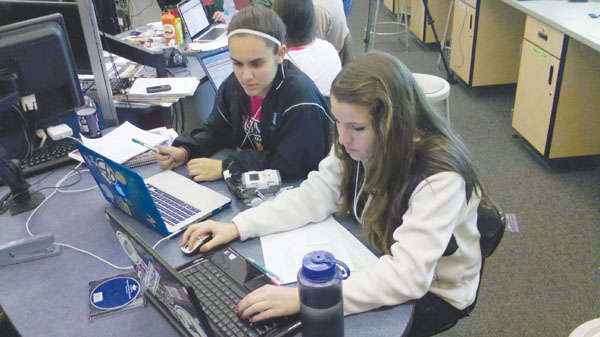
Participants in Saturday’s robotics education workshop used paper- clips, tape and popsicle sticks to build cars in the morning before turning their attention to Lego computers and code writing.
Summit STEM teamed with Colorado State University Extension Service experts to deliver inexpensive STEMaster training for 67 volunteers who will take their newfound knowledge, materials supplied by the college extension service and a passion for extending children’s education in the STEM subjects to kickoff before- and after-school and summer workshops and clubs throughout Summit School District starting within weeks.
The Summit County Extension Office’s 4-H program is the overarching provider of the training and will manage development of STEM programs in Summit School District. CSU Extension specialists from around the state came to Summit to deliver content at the statewide STEM pilot program.
“This is the first program to be implemented,” Summit STEM parent Kathryn Grohusky said. Saturday’s training was a continuation of a Friday evening intro session. On Saturday, volunteers broke into one of four groups – energy, environment, science and robotics – to go more in depth in the field they’d be teaching. The workshops were designed to show volunteers how to teach and use the materials at hand.
“I’ve got tears of gratitude over it multiple times a day,” Grohusky said of the number of volunteers who registered. “That they came on a Friday and Saturday night in the midst of the school year is proof that Summit County is taking this opportunity to enhance (science, technology, engineering and math).”
The plan is to form teams for each elementary school with volunteers from each module. Grohusky said 28 volunteers are dedicated to developing Frisco Elementary’s STEM program. Volunteers on Saturday included 10 of the small school’s teachers, as well as the school’s principal, Renea Hill.
Susan Rose will be stationed at Dillon Valley Elementary, where the after-school program will rotate through the four modules throughout the year. Rose will be teaching robotics during winter.
“I’m looking forward to it,” she said. “It’s something new and exciting.”
She was among 17 volunteers who sat in a lab classroom at Summit Middle School to learn robotics basics. Among those 17 were a handful of Summit High School students wanting to initiate a robotics club in the middle school and help with after-school programs at the elementary schools.
Seven students ranging from freshmen to juniors said they wanted to start the club, which would meet on Wednesdays after school starting in April, because it would “get kids doing things other than going home,” sophomore Karly Rose said, adding that it’s an easy draw because it involves playing with Legos.
Students added that it helps middle schoolers meet more and new people – and it can help with high school transitions. Junior Sam Piehl suggested that, if robotics starts early enough, students can build on their skills to where they create competition teams in high school.
As Adam Goss, a computer science senior at CSU and the CSU robotics intern, led his trainees, his material built on previously learned concepts. He modeled how to convey the material to individuals with varying learning styles and skill levels.
“It’s a hard learning curve but you get it,” Rose said.
“It’s nothing too intense, and you have the materials to help. We’ll be learning with (the students),” Piehl said.
Volunteers moved from creating a verbal “pseudo code” to guide a partner’s movements to writing electronic code through computer software. They learned how a sensor’s input is related to motorized output – and how to make the basics happen – like asking a wheeled robot to travel forward, turn and come back to its starting point.
“It’s very pedantic and you have to pay attention to all the details,” Goss said as his volunteers outlined verbally what they wanted the robots to do. They could try their “code” out on each other to work out bugs before putting it to the test electronically. Throughout the process, teams chatted with each other, then shared thoughts with the class.
Audrey Dignan, Keystone Science School specialty programs coordinator, was one volunteer who spoke up, helping to put some pieces together for the class based on her month of self-taught knowledge and figuring out how to convey that information to kindergartners for her after-school program.
“Think about it like your body,” she said. “Your senses tell you information and then you act on those sensations with your motor functions.”
Elsewhere in the building, volunteers worked on hands-on instruction in science, energy and the environment. Grohusky said some science teachers were waiting for this training before they taught their energy curriculum, because the hands-on exercises would help prepare students to test on state standards.





Support Local Journalism
Support Local Journalism
As a Summit Daily News reader, you make our work possible.
Summit Daily is embarking on a multiyear project to digitize its archives going back to 1989 and make them available to the public in partnership with the Colorado Historic Newspapers Collection. The full project is expected to cost about $165,000. All donations made in 2023 will go directly toward this project.
Every contribution, no matter the size, will make a difference.