Get Wild: A madness of marmots
Get Wild
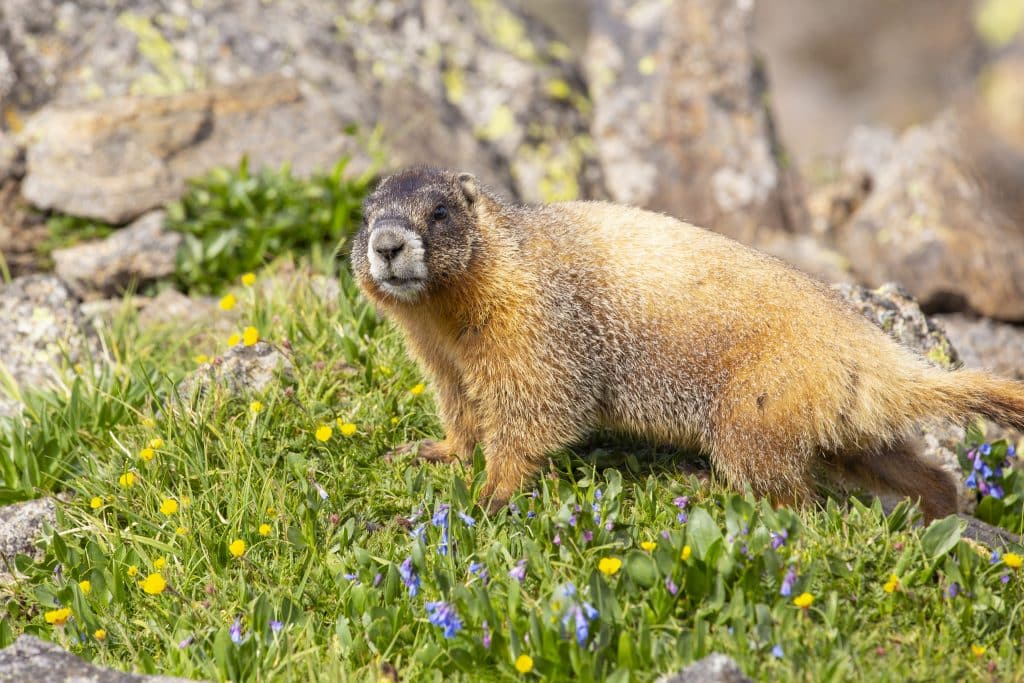
Andrew Maciejewski/Summit Daily News
If you’ve been fortunate enough to get up high this fall — traveling above tree line, that is — nature has treated you to an especially spectacular display of colors in the high-Alpine tundra. As your eyes feasted on the tapestry of reds, oranges and golds, your ears were likely treated to a chorus of whistles and chirps coming from the nearby talus slopes. Out of the corner of your eye, you might have seen a small creature scurry across the rocks.
Yellow-bellied marmots have earned the nickname “whistle pigs” due to their piercingly loud whistle used to alert each other to the presence of a potential predator.
Our local marmots are especially active this time of year because, like our black bear neighbors, marmots need to gain enough weight to survive many months of winter. But unlike black bears, marmots enter a true state of hibernation, in which their body temperature drops to near freezing. Consequently, marmots must double their body weight before entering dens to hibernate.
To den for the winter, marmots use their sharp front claws to burrow many feet deep into the soil beneath boulders. While hibernating, they lose half of their summer weight. If they’re not fat enough, or dig too shallow a den to prevent freezing, marmots won’t wake up come springtime. Interestingly, marmots may be one of the few animals to benefit from climate change, which allows them to emerge earlier from their dens to start eating.
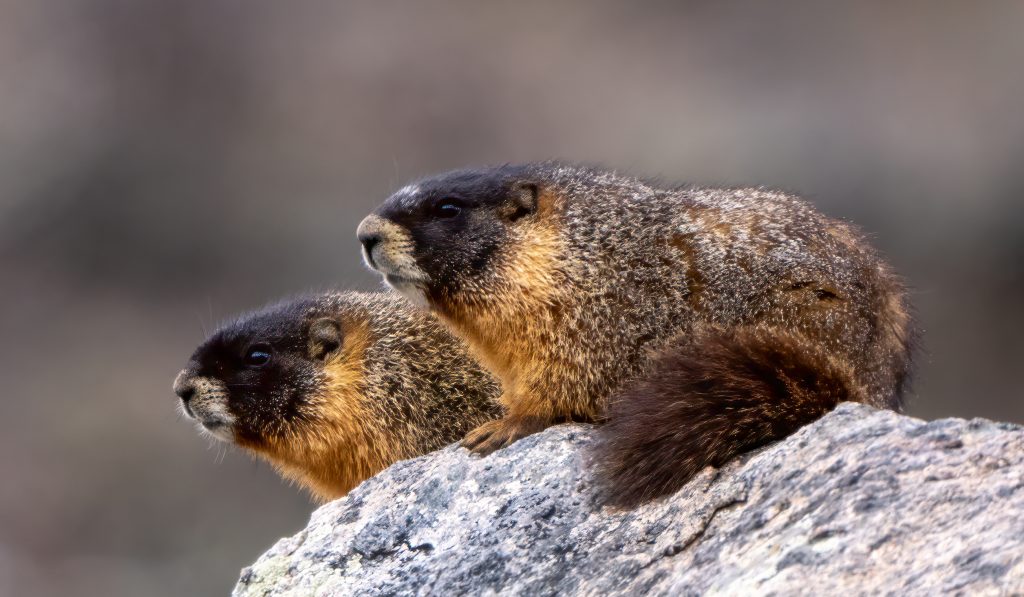
This time of year, yellow-bellied marmots should be plump and waddling, the result of feasting on a diet of flowering stalks, leaves of forbs and grasses and, on occasion, insects and bird eggs. Be sure to keep your dog on leash, which is the law in our local wilderness areas. A curious off-leash dog is viewed as a predator and the perceived threat will cause marmots to expend precious calories.
Marmots are rodents and belong to the squirrel family Sciuridae, along with chipmunks, prairie dogs, and groundhogs. Weighing up to 11 pounds and measuring 26 inches in length, it’s not surprising that Colorado Parks & Wildlife calls yellow-bellied marmot the largest ground squirrel in Colorado.
While their fur is mainly a grizzled brown, yellow-bellied marmots gain their name from their yellowish belly. They also sport white patches around the snout, a dark bushy tail, small, rounded ears and black noses.
In addition to introduced predators like our pet dogs, natural predators that threaten marmots include foxes, coyotes, bobcats, weasels, and raptors like eagles, hawks and owls.
Yellow-bellied marmots live in colonies, usually with one male and a “harem” of females and young. Marmot colonies are actually called “murders!”
Upon sensing danger, yellow-bellied marmots alert the rest of their colony with the familiar high-pitched whistle lasting about half a second. Their vocalizations are quite complex, each whistle and chirp containing valuable information for other marmots. When predators approach, whistles get more frequent, and in extreme cases, like being chased, marmots make fast trills to warn of the increased risk.
Pika or marmot? Often living in close proximity to marmots, though preferring higher habitats above 11,000 feet, the diminutive American pika also makes a loud “eek” when a threat is detected. With practice, you can learn to differentiate the pika’s usually lower-pitched call that lasts slightly longer than a marmot’s chirp.
Intelligent and curious, on our more popular hiking trails marmots can become comfortable with people and assume we’re a reliable food source. They’ll even stowaway in car engines. Remember, don’t feed or approach wildlife. Let’s keep our wildlife wild, and wish our local marmots a safe winter.
Frances Hartogh is a volunteer wilderness ranger and board member for the Eagle Summit Wilderness Alliance.







Support Local Journalism
Support Local Journalism
As a Summit Daily News reader, you make our work possible.
Summit Daily is embarking on a multiyear project to digitize its archives going back to 1989 and make them available to the public in partnership with the Colorado Historic Newspapers Collection. The full project is expected to cost about $165,000. All donations made in 2023 will go directly toward this project.
Every contribution, no matter the size, will make a difference.