Get Wild: Fixing a wilderness gateway
Jim Alexander/Courtesy photo
Meadow Creek trail is a highly used trail right off Interstate 70 at Exit 203. The trail provides access to Lily Pad Lake’s west side and, for more serious hikers, access to Eccles Pass, the beautiful valleys behind Buffalo Mountain, and trails to Vail. All in the congressionally protected wilderness, it is a true wilderness gateway. The Meadow Creek trail is used by 50,000 people a year and the trail shows it. If you hike the trail, you know that it is bad shape. Likely to originally have been a road of some type, it is a wide, steep, eroded path that channels water down its middle. Muddy in the spring, it is dry and dusty in the summer with large boulders in steep areas at the bottom. After entering the Eagles Nest Wilderness, the trail goes through a wet bog and on up to cross the roaring creek, where an old bridge collapsed a couple years ago.
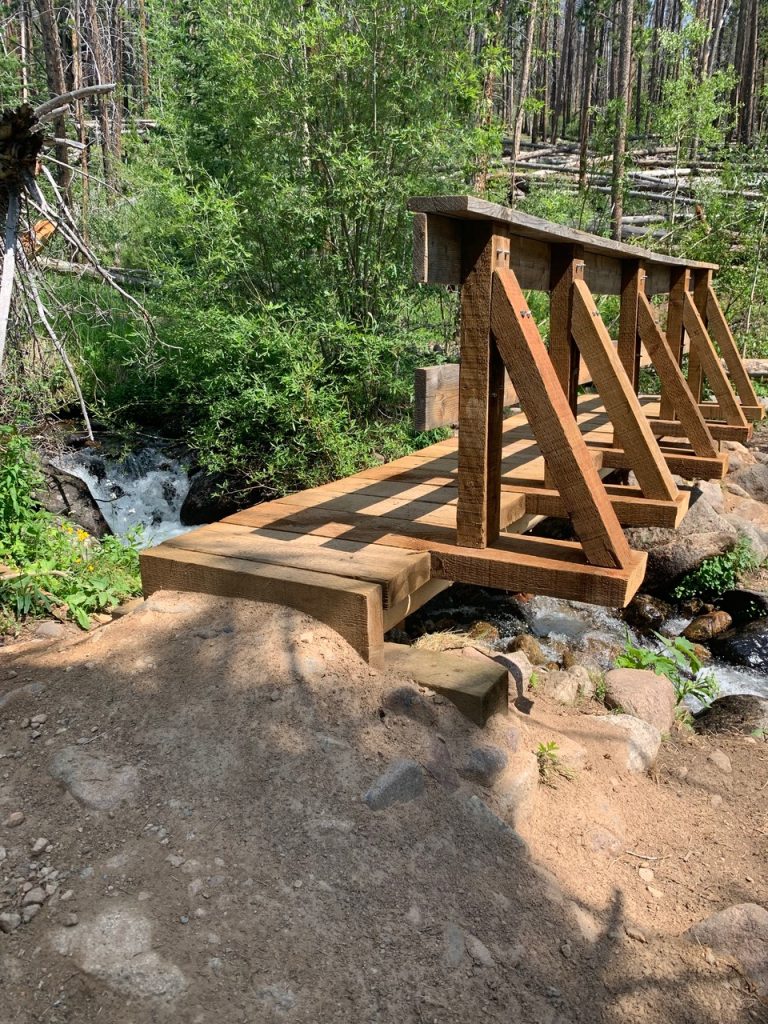
Good news: The bridge has been replaced, and the bog plank trail rebuilt.
Beginning a year-and-a-half ago, the Eagle Summit Wilderness Alliance and the U.S. Forest Service teamed up to plan a major reconstruction over this summer and next. The project, the first in Eagle Summit Wilderness Alliance’s Wilderness Gateways program, is funded by a generous grant from the Colorado Department of Parks and Wildlife, funding materials and labor through the Rocky Mountain Youth Corps.
This year’s work focused on safety, replacing the collapsed bridge. Beginning in June, Eagle Summit Wilderness Alliance sawyers cleared fallen trees from the trail so a Forest Service horse pack-string could carry 650 pounds of lumber and other materials to the bridge site.
Then, over three weeks in July, the Forest Service and the Rocky Mountain Youth Corps crew built bridge foundations, spanned the creek, then installed planking and a handrail. Since it was in the wilderness, no power tools were allowed, so they sawed and drilled by hand.
Luckily, the trail bridge work went faster than expected, so the Youth Corps had time to fix the bog. They felled trees, stripped them of their bark, and created new plank bridges to make the bog walkable.
Last week, Eagle Summit Wilderness Alliance volunteers and Forest Service leaders surveyed the steep trail from the trailhead to the wilderness boundary and planned next year’s work. The goal is to improve the grade of the trail and divert water off the trail to stop erosion. So, the first 0.8 miles of the trail will be reworked over about 3 weeks. The crew will be able to use an excavator (it is outside the wilderness), so the trail will be closed for safety reasons.
We estimate the trail work will require removal of a huge number of boulders and old rock “check steps”. To divert the water from the trail, in each of about seven steep sections, the team will cut one or more “dips” to move the water off the trail. Then, approximately 30 lumber check steps will be created to level out sections of the trail and slow any remaining water flow. Finally, the trail will be groomed so there is better footing.
This work will ensure safer access to the wilderness while also preserving the wilderness character. Areas where trails are difficult or muddy encourage hikers to go around the difficult spots, further cutting into the wilderness. Good trails keep people on them. There is always controversy about how much the wilderness should be opened versus preserving its pristine character. The repaired Meadow Creek will continue to provide good access to the wilderness, while preserving its wilderness character.
Jim Alexander is a Silverthorne resident who has worked with Eagle Summit Wilderness Alliance for six years. He leads the Eagle Summit Wilderness Alliance’s Weed program and the Grant program, which funds several wilderness projects.




Support Local Journalism
Support Local Journalism
As a Summit Daily News reader, you make our work possible.
Summit Daily is embarking on a multiyear project to digitize its archives going back to 1989 and make them available to the public in partnership with the Colorado Historic Newspapers Collection. The full project is expected to cost about $165,000. All donations made in 2023 will go directly toward this project.
Every contribution, no matter the size, will make a difference.