Court dismisses Summit County Sheriff’s lawsuit against commissioners

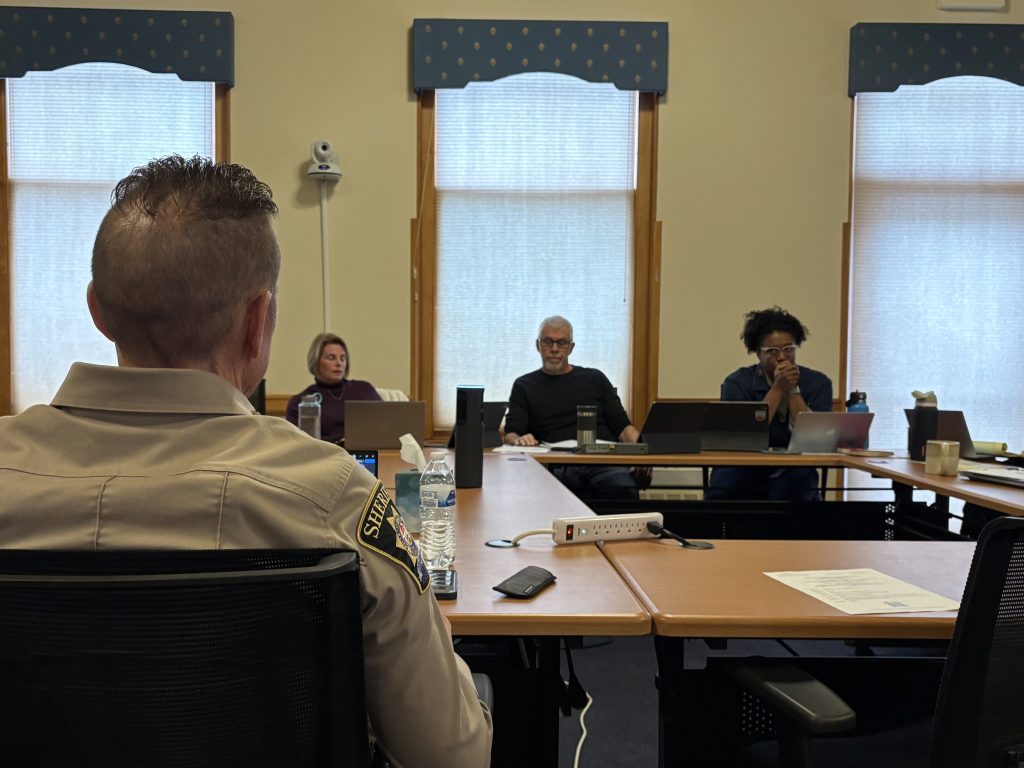
Kyle McCabe/Summit Daily News
A Summit County district court Dec. 4 dismissed Summit County Sheriff Jaime FitzSimons’ lawsuit against the Summit Board of County Commissioners related to the board’s denial of a budget appropriation request.
The appropriation request was related to salaries and staffing expenses, as the Sheriff’s Office’s spending in those areas went over its 2024 budget for the third year in a row. The commissioners adopted a resolution denying the request May 13, and FitzSimons filed his lawsuit June 10.
Judge Reed Owens ruled in a 21-page decision that FitzSimons’ complaint did not meet standards set in the Colorado Rules of Civil Procedure and precedent case law of making a “plausible claim that the Board clearly abused its discretion by acting arbitrarily or unreasonably” in denying his FitzSimons’ appropriation request. Because it did not meet that standard, Owens granted the commissioners’ motion to dismiss the case.
Owens wrote in his decision that the court would analyze the sheriff’s claims with a presumption of truth to determine if they “state a plausible claim for relief.” Claims that were “bare legal conclusions,” like claims that the board “was not motivated by good faith budgetary concerns,” and not “factual allegations” did not receive a presumption of truth.
“The Sheriff must allege facts, not labels, from which an abuse of discretion can reasonably be inferred,” Owens wrote.
The sheriff faced a “heavy merits burden,” Owens wrote, because Colorado law states courts must give deference to board of county commissioner determinations and assume board budget decisions are valid uses of their power unless the board “clearly abuses its discretion” by acting “arbitrarily or unreasonably.”
Relevant case law states the sheriff showing his office had a “reasonable need” for the excess funds is not enough to prove abuse of discretion, Owens wrote.
Under those standards, Owens considered whether the sheriff had stated a “plausible abuse of discretion claim” in four categories.
The first had to do with the sheriff’s claims that the county had miscalculated the needed funding for his office’s “Step Plan,” which gave annual wage increases between 5% to 7% to certain law enforcement positions for their first five years of service, but given approvals for budget appropriations for the excess spending that resulted from that miscalculation.
Owens wrote that the allegations, taken as true, show that the sheriff operated on the assumption that employees would receive Step Plan pay increases and the excess spending be covered through budget amendments. This demonstrated a “reasonable need” for the additional funds and a prior history of funding, Owens wrote, but those demonstrations do not prove that the board’s decision was a “clear abuse of discretion” or “arbitrary or unreasonable.”
The second category, prior over-expenditures and excess county revenue, addressed the sheriff’s claims that the county previously approving similar appropriations for overtime and salary overages and possessing “excess” revenue at the time of its appropriation denial made the decision an abuse of discretion.
The board stated its reasoning for denying the request was that the Sheriff’s Office exceeded its 2024 budget and that the sheriff did not provide “sufficient detail or documentation to support the requested amount.”
Owens wrote that the sheriff’s complaint did not state he provided information that the board is “statutorily required” to consider before approving an appropriation. He added that the complaint did not allege that the board had a legal obligation to fund salary and overtime expenditures in excess of the Sheriff’s Office’s budget.
The sheriff’s allegations that the county possessed excess revenues “are sparse,” Owens wrote. The sheriff’s complaint does not allege if those revenues “were unencumbered” or available for the county to spend on the Sheriff’s Office. Owens wrote that describing revenues as “excess” does not mean they were “free of legal or practical constraints” or that the board was obligated to spend them on the Sheriff’s Office’s shortfall over other priorities.
Owens wrote that the sheriff’s claims of over-expenditures and excess county revenue did not “plausibly establish” that the appropriation rejections was “so unfounded as to amount to a clear abuse of discretion, rather than a contested but legally permissible fiscal judgement.”
The third category, finance director and county manager approvals, relates to the sheriff’s claim that those county staff members allegedly approving the appropriation shows that the request “was not facially untenable” and that county staff saw it as a “legitimate” need, not a “frivolous or fiscally impossible proposal.”
The board argued that the recommendations or approvals of staff, like the finance director and county manager, cannot force the board to adopt a particular resolution or render the board’s decision arbitrary or unreasonable. Owens, citing state law, agreed with the board’s argument, although he wrote that the approvals “modestly support the Sheriff’s broader theory” that the board’s decision “treated his office differently,” as other departments received allocations of additional revenues in the same timeframe, according to the sheriff’s claims.
The court considered the alleged staff approvals “only as limited circumstantial evidence,” Owens wrote. He stated that the approvals “do not, by themselves, establish” that the board’s decision was arbitrary or unreasonable.
The final category, political animus, relates to the sheriff alleging that the board was motivated not by “good-faith budgetary concerns,” but by political animus and a desire to encroach on his statutory responsibilities.
Owens wrote that several claims in this category, like that the board “sought to reduce confidence in the Sheriff through political machinations,” were not “well-pleaded facts” and could not be assumed to be true.
The remaining claims, Owens wrote, show a “pattern of institutional friction,” like conflicts over what entity controls the office of emergency management, how vendor payments are processed and the payment of attorney’s fees.
The sheriff’s complaint does not “directly connect” the conflicts between the board and Sheriff’s Office to the board’s denial of the appropriation request, Owens wrote. He added that the complaint did not show that the board’s decision fell outside of the board’s “legal realm.”
The political animus claims “provide background context,” Owens wrote, but do not “transform a budget disagreement into a plausible claim of abuse of discretion.”
Owens wrote that the four categories, standing alone or considered collectively, do not show that the board’s decision falls outside of the “broad range of fiscally grounded choices” precedent case law permits.
“A demonstrated operational need, internal staff support, some available revenue, and a contentious working relationship are all factors a board may consider,” Owens wrote. “They do not, without more, plausibly establish that a denial of supplemental funding was arbitrary or unreasonable.”
Summit County Communications Director Adrienne Saia Isaac provided a statement on behalf of the board that stated the commissioners were pleased with the decision. It stated the decision “affirmed” the board’s authority to make budget decisions for the county.
“It allows all of us to get back to business on a more positive, collaborative path — without distraction,” the statement read.
The commissioners look forward to “redirecting taxpayer dollars from unnecessary legal fees” to other programs and services, “including funding public safety at appropriate and sustainable levels,” the statement read.
In a separate statement, FitzSimons wrote that he respects the court and its role in the process but is disappointed with the outcome.
“I brought this action because I believed — and continue to believe — that the issues raised were significant for the long-term stability of public safety services in Summit County,” FitzSimons wrote.
FitzSimons wrote that he will consider “what is in the best interest” of the community, his staff and the future of his office in deciding whether to appeal the decision. He wrote that he will consider whether the “additional cost of litigation is an appropriate use of taxpayer dollars.”
FitzSimons stated he will “continue to advocate” for resources needed to “fulfill our statutory obligations” and serve the community. He concluded that he will provide further updates after evaluating the ruling and next steps. The sheriff’s other lawsuit against the board, which had to do with a disagreement about the board’s authority over the office of emergency management, was dismissed Aug. 6 in a voluntary dismissal filed by FitzSimons’ legal representation. The board had voted to move the office from the Sheriff’s Office to the county manager’s office in July.






Support Local Journalism
Support Local Journalism
As a Summit Daily News reader, you make our work possible.
Summit Daily is embarking on a multiyear project to digitize its archives going back to 1989 and make them available to the public in partnership with the Colorado Historic Newspapers Collection. The full project is expected to cost about $165,000. All donations made in 2023 will go directly toward this project.
Every contribution, no matter the size, will make a difference.