Get Wild: What you need to know about wildlife encounters in Colorado’s backcountry
Get Wild
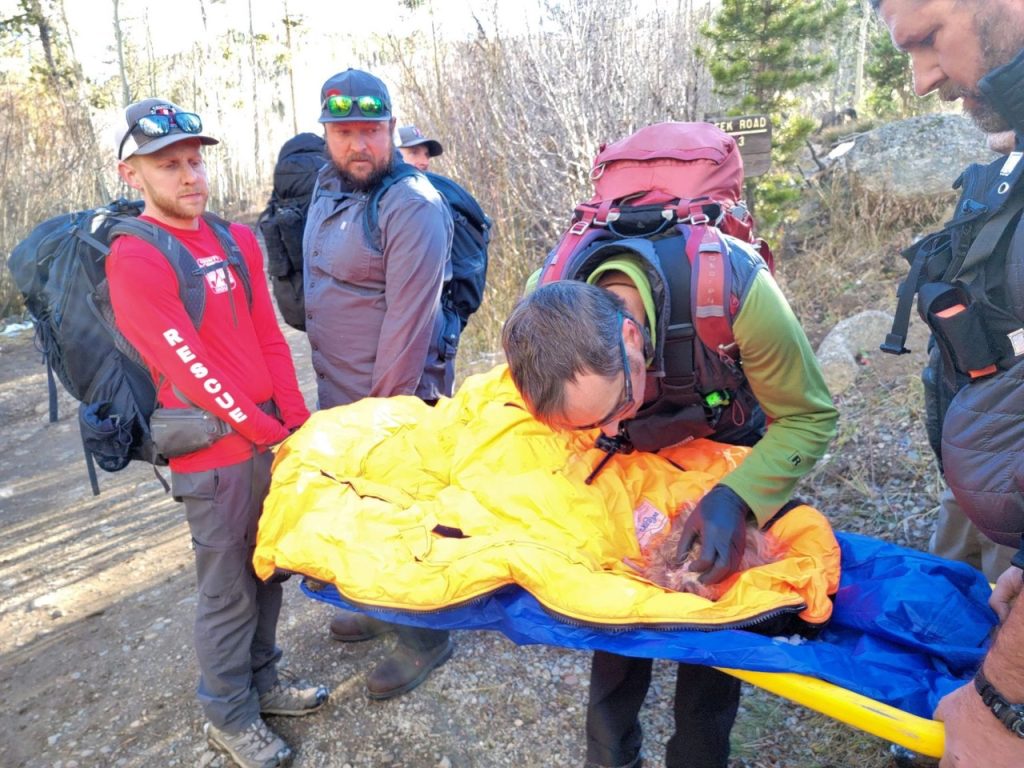
Anna DeBattiste/Courtesy photo
One fine fall day in Summit County, a little dog named Arlo was walking on the Rainbow Lake Trail with his family. He had trotted a bit ahead of his owners when suddenly three moose appeared on the trail between Arlo and his people. Arlo tried to get back to safety, but one of the moose stomped him repeatedly.
Arlo was still breathing when the Summit County Rescue Group arrived to carry him out, but his eyes were vacant and he was unresponsive. His owners rushed him to a veterinary clinic, but later that day, Arlo’s owners messaged Summit County Rescue Group’s coordinator that the vet had put him to sleep.
Raise the subject of dangerous wildlife encounters and many backcountry recreationists think first of bears and mountain lions, yet Colorado Parks and Wildlife reports that more people are attacked by moose than any other wild animal. Many attacks start because of a dog. A moose will react to a dog as it would to a wolf, its natural predator, by charging the dog to defend itself. If the dog runs back to its people, that puts the people in danger, too.
Wild animals in Colorado are best viewed from a distance and left alone. Here are some safety tips.
Moose
Unlike most bears and mountain lions, moose are generally unafraid of people. If they feel threatened, or especially if a cow moose has calves with her, they will charge and attack. They can run up to 35 mph and weigh up to 1,200 pounds, so the damage they can inflict is not to be underestimated.
Obviously, the most important first step to keep you and your dog safe from moose is to keep your distance and keep dogs leashed. Should you end up too close to a moose, watch for signs of aggression — snorting, raised hackles and pinned ears. While experts recommend backing slowly away from most wildlife, a moose encounter is different; you should get away as quickly as you can. If possible, put a large object like a tree, car, snowmobile or ATV between you and the moose. Learn more about moose encounters and moose and dog safety on Colorado Parks and Wildlife’s website.
Bears
If you run into a bear on the trail, don’t run. Stand still and speak in a normal voice to make the bear aware of you, and it will probably move away. If the bear approaches you, instead, make yourself look as big as possible and back slowly away. Never turn your back, and run and don’t climb a tree, since bears climb trees too. If you’re on a trail, step off on the downhill side. Be especially careful if you see bear cubs; that means a protective mother bear is likely nearby.
Colorado Parks and Wildlife reports that on the rare occasion when a bear has attacked and injured a human, it is usually because the person blocked the bear’s escape route. On rarer occasions, the bear has been food-conditioned by humans, has lost its natural fear of people and is willing to attack to get food. This generally forces Colorado Parks and Wildlife to euthanize it.
If you’re attacked by a bear, fight back with everything you’ve got. Yell, throw rocks and use bear spray if you have it. “Convince the bear you’re not worth the trouble,” Colorado Parks and Wildlife advises. Learn more about Colorado bears on Colorado Parks and Wildlife’s website.
Mountain lions
Mountain lion encounters are rare and brief, and lion attacks are even rarer. Should you encounter one, Colorado Parks and Wildlife’s advice is much the same as for bear encounters. Stay calm, make noise and back away. Make yourself look larger, and don’t run. If the lion attacks, fight back any way you can — grab a stick, throw a rock or use your mountain bike as a weapon. Read more about mountain lions on Colorado Parks and Wildlife’s website.
Wildlife sightings are one of the things that make backcountry recreation in Colorado so special. Most human-wildlife conflicts, however, are caused by our encroachment on wildlife habitat. Respect wildlife by keeping your distance and cultivating their natural fear of humans. Never feed any kind of wildlife — ever. You may think you’re doing them a favor, but you’re not. Feeding wild animals encourages them to wander into developed areas and lose their fear of humans. That’s dangerous for people and pets, and dangerous for the animal too, who may have to be destroyed to protect public safety. Feeding wildlife also leads to disrupted natural behavior, the spread of disease, and negative impacts to wildlife health.
Special thanks to Arlo’s family, who graciously agreed to allow his sad story to be used for educational purposes.

“Get Wild” publishes on Fridays in the Summit Daily News. Anna DeBattiste is a volunteer public information officer with the Colorado Search and Rescue Association and a former public information officer with Summit County Rescue Group, both of which are 501(c)(3) nonprofits that rely on donations and grants for their operations. The Colorado Search and Rescue Association provides advocacy, resource coordination, member education and collaboration forums for backcountry search and rescue teams and other partners across the state.
Bureau of Land Management nets over $4.8 million in Colorado oil and gas lease sale
The Bureau of Land Management’s third quarter oil and gas lease sale on Thursday, Sept. 10 amassed around $4.88 million as the agency leased 14,212 acres in Arapahoe, Jackson, Moffat, Rio Blanco, Routt and Weld counties.



Support Local Journalism
Support Local Journalism
As a Summit Daily News reader, you make our work possible.
Summit Daily is embarking on a multiyear project to digitize its archives going back to 1989 and make them available to the public in partnership with the Colorado Historic Newspapers Collection. The full project is expected to cost about $165,000. All donations made in 2023 will go directly toward this project.
Every contribution, no matter the size, will make a difference.