Major project to reshape Exit 203 in Frisco with goal of easing heavy Colorado mountain traffic to begin next week

The Colorado Department of Transportation will begin work at one of Summit County’s busiest interchanges, Interstate 70 Exit 203, in Frisco on Monday, April 20. 

Contractor Zak Dirt and CDOT crews will work day and night shifts Monday through Saturday with occasional Sundays as needed, according to a news release sent by Austyn Dineen, Interstate 70 mountain corridor communications manager. Day shifts will be from 7 a.m. to 7 p.m. while night shifts will be 7 p.m. to 7 a.m.

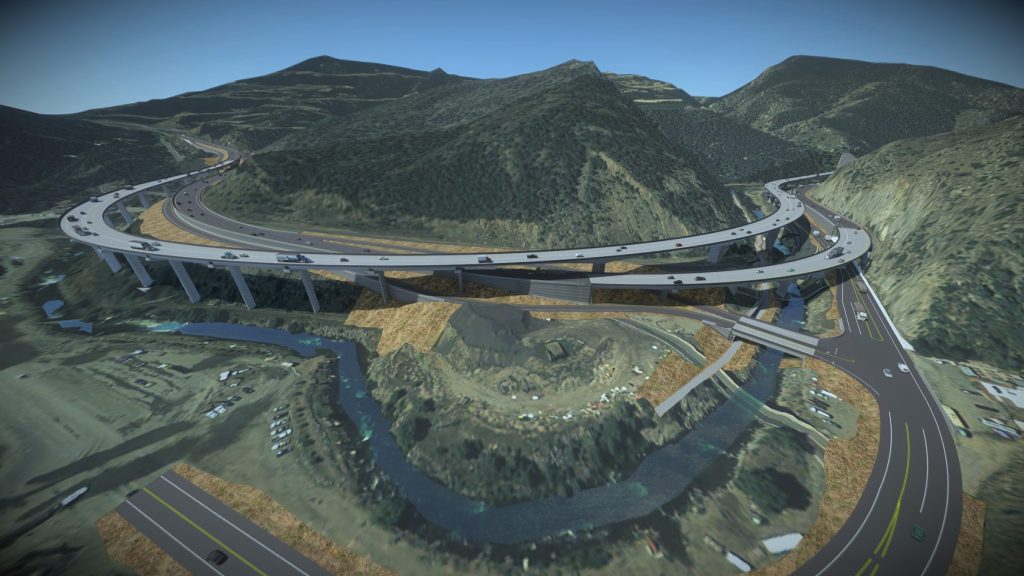
The project aims to reduce traffic congestion, enhance safety features and add bicycle and pedestrian connections along Colorado Highway 9, Lusher Court and Dillon Dam Road at the north end of Frisco — an area that has long experienced heavy backups during peak travel times. 

In early May, CDOT has planned a short-term daytime detour on Dillon Dam Road to accommodate a sewer installation. Otherwise, CDOT plans to only close lanes on Highway 9 and Interstate 70 during nighttime hours — between 7 p.m. and 7 a.m. — to minimize impacts to daytime traffic. During the night shift, crews will place lane barriers and begin re-striping. 

No full road closures are anticipated during the first stage of construction, which is scheduled to end before November of this year. The second stage will likely commence in April 2027 following a winter shutdown. While CDOT has said impacts will be felt during both construction seasons, officials have indicated that 2027 will likely bring the most disruption as major roadway features are completed. 

Construction will occur in multiple phases, with work this year focusing on foundational elements, including work on the Interstate 70 bridge structure, retaining walls and part or all of a new Highway 9 underpass. Next year, crews are expected to complete the bridge and construct a new frontage road bypass under Highway 9 to link Dillon Dam Road and Lusher Court to further relieve traffic at the interchange just slightly to the north. 

The first phase of work also entails a short-term reconfiguration of traffic lanes along Highway 9 and the Interstate 70 exit ramps to allow roadwork to proceed safely. Additionally, CDOT plans to widen the Interstate 70 overpass and add a 10-foot-wide multi-use path to more safely accommodate cyclists and pedestrians traveling over the interstate. 

While exiting onto the I-70 westbound offramp for Exit 203 will remain a single lane, widening the offramp to two lanes should better hold traffic, according to Scott Harris, project manager with CDOT. Eventually, a traffic signal will be added to the I-70 westbound Exit 203 offramp in lieu of a roundabout. 

CDOT Executive Director Shoshana Lew wrote in a news release that the project to redesign the Interstate 70 mountain corridor, starting with Exit 203, has been in development for nearly five years.

Colorado Department of Transportation/Courtesy illustration
The Colorado Depatment of Transportation hosted an open house Wednesday, Oct. 25, 2023, where residents could learn more about the Interstate 70 Exit 203 Interchange Project.
Colorado Department of Transportation/Courtesy illustration

“Breaking ground on the Exit 203 project marks a major milestone for the Interstate 70 mountain corridor, the primary thoroughfare to our popular mountain communities,” Lew wrote. “By enhancing multimodal access through regional services like Bustang and county-wide offerings like the Summit Stage, we are ensuring a safer, more efficient interchange for our local residents and the millions of visitors who travel through this gateway.” 


Stay connected to Summit County.

Sign up for daily or weekly newsletters at SummitDaily.com/newsletter


The Exit 203 interchange has long been identified as a chokepoint in Summit County’s transportation network, particularly during peak travel seasons when a larger volume of interstate traffic converges with local travel along Highway 9. The heavy traffic and congestion — driven both by daily commuters and vacationers heading to ski resort and recreation areas — frequently lead to back-ups on exit ramps and create safety concerns for drivers, cyclists and pedestrians. 

Transportation officials say the redesign will separate local and through traffic, reduce stop-and-go conditions and modernize infrastructure that has struggled to keep pace with growing demand. 

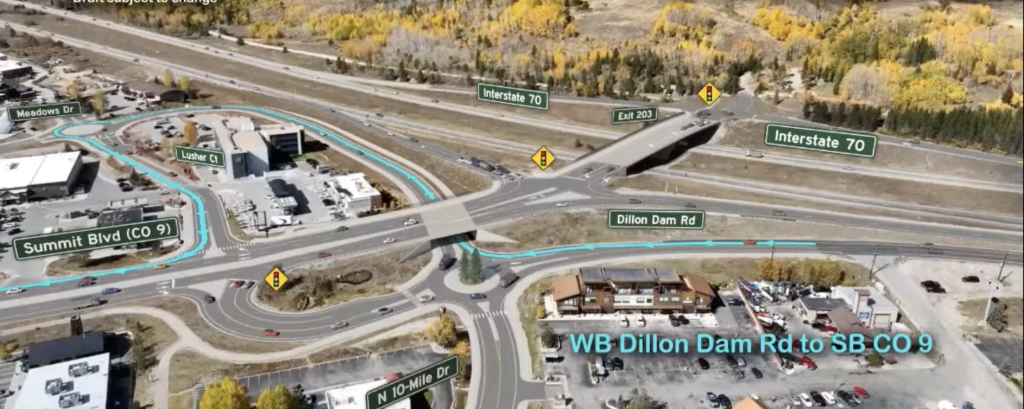
This rendering of Exit 203 demonstrates how the area will look different once construction is completed. The blue line represents the new route that will need to be taken by those exiting Dillon Dam Road on the Frisco side.
The Colorado Department of Transportation/Courtesy illustration

Construction will also address aging stormwater and utility infrastructure between Highway 9 and Dillon Dam Road. According to CDOT officials, the combination of traffic capacity improvements, expanded travel options and safety upgrades will better accommodate growth in both local populations and visitor numbers while reducing congestion at one of the county’s busiest gateways. 

Residents interested in learning more about CDOT’s planned construction near Frisco can access a project resource page at CODOT.gov/projects/i70-exit203-interchange-frisco, or sign up for project updates at Subscription.COtrip.org.

Here’s where CDOT expects construction to have traffic impacts on the I-70 mountain corridor as roadwork season kicks off

After a historically low-snow winter, the Colorado Department of Transportation is kicking off projects along the Interstate 70 mountain corridor as the construction season once again gets underway.

On I-70, continued work on  Floyd Hill and West Vail Pass will once again result in significant roadway impacts, including holds and shifts in traffic patterns, CDOT communications manager Austyn Dineen said in an email.

Other projects, such as the two-year project to build a new interchange at Exit 203 to Frisco or repairs to bridges through Glenwood Canyon, will also result in some less significant traffic impacts, such as delays and lane closures, Dineen said.

With the hot, dry conditions this past winter, she said the transportation department expects elevated fire danger this summer, so drivers should dispose of cigarette butts properly, secure any chains to prevent sparks and report any fires immediately.

Here’s a deeper look at how construction projects planned on I-70 will impact summer travel.

Floyd Hill

The three-phase Floyd Hill project will overhaul an 8-mile stretch of I-70 between Evergreen and Idaho Springs. The Colorado Department of Transportation discussed the Floyd Hill project and several other projects at a telephone town hall Monday, June 9, 2025.
Colorado Department of Transportation/Courtesy illustration

The I-70 Floyd Hill project is entering an “important, new phase of construction” as crews work to realign westbound I-70 from its current location to the hillside south of Clear Creek, according to the transportation department.

Located between Evergreen and Idaho Springs, the nearly 8-mile project began in 2023, with work expected to last through the end of 2029. The roughly $900 million project aims to widen the canyon, build new interstate bridges with gentler, safer curves and remove an existing bottleneck on westbound I-70 at the top of Floyd Hill.

Construction of a cast-in-place segmental bridge, which will carry the new westbound I-70 alignment, kicked off this spring and will continue through mid-2027, according to CDOT.

Crews on movable platforms will reportedly build the bridge above live traffic until the full span of the bridge connects.

Throughout the summer, drivers can expect temporary I-70 lane and ramp closures, traffic holds for rock blasting, new traffic patterns, narrowed lanes and shoulders and reduced speeds, Dineen said. Flaggers and alternating traffic will also be required this summer on U.S. Highway 40 near Floyd Hill.

The 20-minute holds for rock blasting are planned to occur Mondays through Thursdays from about 9 a.m. to 3 p.m. and between 9 a.m. and noon and Fridays, according to the transportation department.

Drivers can sign up for text alerts about the Floyd Hill Project by texting “floydhill” to 21000 or visit CODOT.gov/projects/i70floydhill for more information.

West Vail Pass

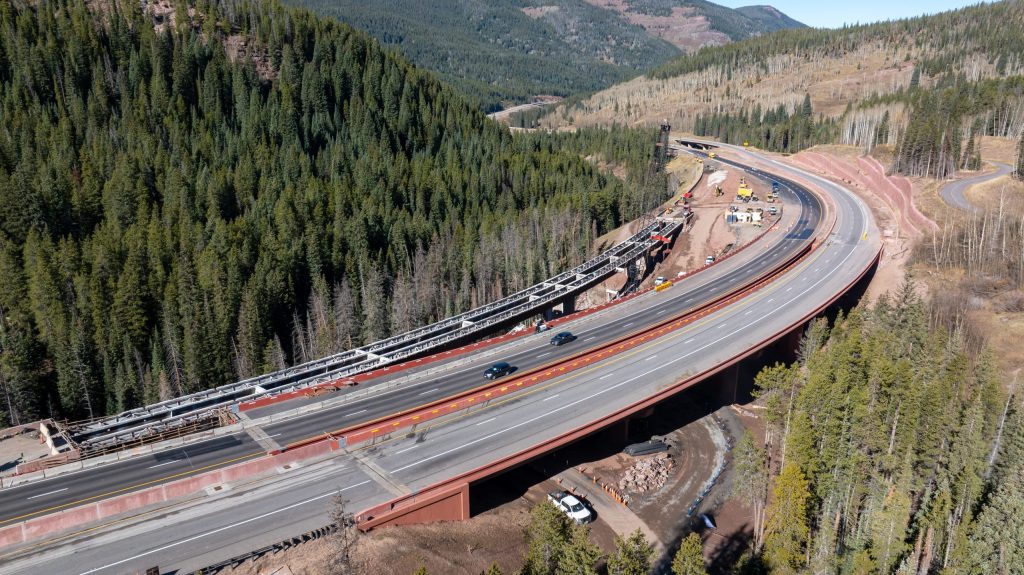
Construction advances on a new bridge along Interstate 70 near East Vail and Vail Pass. The new bridge is part of the West Vail Pass Auxiliary Lane Project that is expected to be completed in 2026.
Colorado Department of Transportation/Courtesy photo)

Now in its sixth — and final — year of planned construction, the West Vail Pass Project aims to bring a number of safety improvements to a roughly 10-mile stretch of I-70 with steep grades and tight curves.

This year, crews are planning to complete work on six wildlife crossings, an avalanche and rockfall mitigation system for the area known as The Narrows and resurfacing of westbound I-70. The work will also include landscaping and final improvements to the recreation path between the new bridges.

Beginning Monday, April 20, there is a possibility of daily single-lane closures along eastbound and westbound I-70 from Mile Post 180 to 190, according to the transportation department.

Starting in May, crews will shift I-70 traffic into a head-to-head, barrier-separated alignment in the new eastbound lanes to allow for roadway and wildlife underpass construction.

From early to mid-June, rock scaling is expected to require traffic holds from Monday to Thursday from about 9:30 a.m. to 2:30 p.m. each day.

From mid-June to early September, installation of the new avalanche and rockfall mitigation system will require occasional 20-minute traffic holds on I-70 in both directions. Only a few traffic hold days are anticipated.

Night work is possible anytime during the construction season, but is expected to become more consistent toward the end of the project.

The Vail Pass Recreation Path will remain open and accessible to riders and trail users through the season, with similar impacts to previous years. Intermittent trail holds for construction access may occur, and variable trail conditions could exist through construction areas. There 

are no anticipated extended recreational path holds scheduled this summer.

Drivers can sign up for text alerts about the Floyd Hill Project by texting “vailpass” to 21000 or visit CODOT.gov/projects/i70westvailauxiliarylanes/construction for more information.

Interchange construction at Exit 203 to Frisco

The Colorado Department of Transportation also plans to start construction on the I-70 Exit 203 Interchange Project in Frisco on Monday, April 20. This two-year project aims to reduce a dangerous backup that occurs on I-70 near Exit 203 as well as make other improvements for pedestrians and vehicles in the area.

Work will occur Monday through Saturday from 7 a.m. to 7 p.m., with occasional Sunday work as needed, according to the transportation department. No full closures are expected during the first season of construction, and during the day, two lanes of travel on I-70 will remain open. 

Nighttime lane shifts are planned on I-70 and Colorado Highway 9 from 7 p.m. to 7 a.m.

For more information on the project, call the project information line at 970-817-8647 or visit CODOT.gov/projects/i70-exit203-interchange-frisco.

Other projects with travel impacts

The Colorado Department of Transportation also has a number of other projects on I-70 that will result in fewer travel impacts this summer.

After work began last summer, the transportation department plans to wrap up the I-70 Glenwood Canyon Bridge Joint Improvement Project this fall. The project includes replacing 23 bridge joints and conducting other bridge repairs through the canyon. During weekdays this summer, the project will require single lane closures in both directions.

Between Exit 205 to Silverthorne and the Eisenhower-Johnson Memorial Tunnels, culvert repairs will require single-lane and shoulder closures in both directions.

From Exit 253 to Chief Hosa to Exit 262 to Morisson, drivers can expect a westbound lane shift with reduced shoulder and lane widths and single- and double-lane closures during the night, beginning in mid-July, according to CDOT.

Man arrested on charges of soliciting for prostitution of a minor sentenced to supervised probation

A 5th Judicial District Court Judge on April 13 sentenced a man Summit County Sheriff’s Office deputies arrested in August 2024 as part of an undercover operation related to child prostitution.

The undercover operation, conducted by the Summit County Sheriff’s Office, Colorado Bureau of Investigation and other agencies, led to the arrest of three men. Law enforcement officers stated Isaiah Rapheal Brown, 34, and the other men arrested arrived “separately and independently” at agreed-upon locations in Summit County with the intent to pay for sexual acts with children.

Brown pleaded guilty to a Class 5 felony for cybercrime solicitation or arranging the prostitution of a minor. Judge Reed Owens followed the recommendation of the plea agreement the prosecution and defense reached prior to the hearing, sentencing Brown to four years of supervised probation with conditions specific to sex offenders.

Brown’s plea dismissed felony charges for soliciting for child prostitution, attempted patronizing a prostituted child, attempted sexual assault on a child and two counts related to human trafficking of a minor for sexual servitude. It also dismissed a misdemeanor charge for attempted contributing to the delinquency of a minor.

In September 2025, Brown entered pleas of not guilty on all counts, but he withdrew those pleas when he accepted a plea deal in January. The court had a jury trial scheduled in March for Brown until the parties informed the court they had reached a plea deal, according to court records.

At the sentencing hearing April 13, public defender Christopher Claypool, who represented Brown, said that Brown had complied with all court orders since his 2024 arrest and proven he is a good candidate for probation. Claypool said Brown has struggled with employment since his arrest but currently has a job, a place to live and a long-term relationship.

Claypool asked Owens to modify two conditions of the probation, relating to Brown’s allowed use of social media and gaming devices, because Brown makes supplemental income from social media businesses and competitive gaming. Claypool said that Brown had mental health issues at the time of his arrest but has been addressing them since through medication and therapy.


Stay connected to Summit County.

Sign up for daily or weekly newsletters at SummitDaily.com/newsletter


Deputy district attorney Jeanine Svoboda said the prosecution had no objection to the condition modifications, but Owens imposed them during sentencing. Owens suggested Brown should work with the probation office to try to carve out exceptions for his employment considerations.

Owens found Brown does not meet the criteria to be considered a sexually violent predator, but he said Brown will have to comply with sex offender-specific probation conditions. Brown’s sentencing requires him to pay costs and fees totalling about $3,000, according to court records.

Before dismissing Brown, Owens wished him luck, saying he should follow probation conditions just as he had successfully followed all bond conditions and court orders between his arrest and sentencing.

The other men arrested in the same undercover operation as Brown had previously been sentenced in February and in December 2025. Both of those men received jail time as part of their sentences, with one receiving 21 days and the other 60. Both received five years of sex-offender specific supervised probation as part of their sentences as well.

Summit County and town managers discuss fire, water, construction, projects, tourism and more at forum event

Six town managers and one deputy county manager participated in the 15th annual Town and County Manager Forum on April 9.

The discussion at the Summit County Community and Senior Center included three “pillars” — wildfire, water and safety; construction and development; and local economy and tourism. Two of the town managers, Silverthorne’s Greg Camp and Blue River’s Chad Hull, started at their positions in the last two months, while the others have all been in their roles for two or more years.

Summit Chamber executive director Cheri Ryan and Altitude Realtors CEO Sarah Thorsteinson, whose organizations partnered to put on the event, moderated the discussion. Thorsteinson said the managers have talked about topics from budgets and taxes to short-term rentals and transit in the past, but the hosts wanted to keep a specific focus this year with the three topics.

Wildfire and water

The managers introduced themselves before discussing wildfire and water issues. All the managers said Summit Fire and EMS, the Red, White and Blue Fire Protection District and the U.S. Forest Service have been good partners and communicators with the towns and county in preparing for wildfire season.

Managers also spoke about following fire restrictions, with several mentioning that the fire conditions have not yet met the standards for implementing restrictions. Steve Greer, a Summit County deputy manager, mentioned that the Summit Board of County Commissioners held a special work session on wildfire preparedness in March. He said it will host another soon because it did not touch on all the planned topics, like Xcel Energy safety shutoffs and evacuation protocols.

Keystone’s John Crone said officials hope an El Nino weather pattern will bring rain to Summit County. He and the other managers also emphasized the importance of communication in wildfire preparedness, praising the fire districts for their efforts to make sure people are aware of fire dangers and ready to evacuate if needed.

On the topic of water, Shannon Haynes, Nation Johnson and Tom Fisher — the managers for Breckenridge, Dillon and Frisco, respectively — all said they expect their towns to implement water restrictions this summer. Crone said Keystone does not control its water, but the water district that does may implement restrictions.


Stay connected to Summit County.

Sign up for daily or weekly newsletters at SummitDaily.com/newsletter


Blue River’s Chad Hull said the town’s residents get water from individual wells, which are in a “fairly healthy position.” Blue River aims to make residents aware of how their water use will affect users downstream, Hull added. Silverthorne’s Greg Camp said the town gets most of its water from wells, and although they look healthy now, the town will monitor them throughout the summer.

Construction and development

Hull kicked off the construction and development conversation by saying Blue River does not have as strong an emphasis on “exterior-facing economic development” as other towns, focusing more on short-term rentals and partnerships with real estate groups. The main construction Hull had to highlight was the town’s ongoing efforts to shore up dirt roads built before the town was incorporated. 

In Silverthorne, Camp said, the “bottom line (is) there’s a lot going on.” He mentioned the recent opening of the Old Dillon Inn inside Bluebird Market and the ongoing construction of other buildings nearby, including a Holiday Inn Express and workforce housing. He also highlighted parks and recreation construction projects, like a new playground at Smith Ranch.

“It’s about a $0.5 million project,” Camp said. “It is an innovative playground. It’s really going to be one that is not just for the littles, but for the ones that are a little bit older.”

Greer said unincorporated Summit County does not have many major construction projects right now, but he noted that the county recently updated its building codes, including fire codes. He also pointed out the “significant” construction at the county dump that includes adding new cells for trash storage and this summer’s county-funded road construction, which includes an approximately 14-week closure of part of Swan Mountain Road.

Dillon will replace some of its Town Park tennis courts with pickleball courts this summer, Johnson said. He said other work at the park to complete its plaza will start in the fall after the farmers market season wraps up. 

For private projects, Dillon recently saw a crane installed at the Waterview Residences and expects construction to get underway soon. A Nordstrom Rack should open in the old Bath and Body Works later this year, Johnson said, and there are plans to turn the movie theater site into a housing project, which he said will include workforce housing and be mostly rentals.

Johnson also spoke about the town’s urban renewal authority purchasing the Pug Ryan’s Brewing Co. building and an adjacent one in February. He said the acquisitions are related to an intergovernmental agreement the Town Council signed with Colorado Mountain College to pursue an expanded campus for the college, student and workforce housing, parking and more.

“We’re also looking at expanded daycare potential and other things,” Johnson said.

Keystone has a lease purchase agreement in place for the Keystone Center, Crone said, and is doing design work to add housing and community space around it. The town is also looking for land to build parks in town. He also mentioned that Keystone has several capital projects to improve sidewalks, especially along U.S. Highway 6.

Fisher said Frisco has around $300 million of private and public construction and development going on in the town. He highlighted the Foote’s Rest project, plans for a 24-hour McDonald’s on Summit Boulevard, two workforce housing projects near Main Street and the planned Prime Lofts development. Fisher also mentioned the construction on Interstate 70’s Exit 203, which will start this summer.

The town aims to mitigate the impact the construction around town has on tourists, Fisher said.

“They’re going to notice,” Fisher said. “But if they can still move around, park, do all the things that they need to do, which is really our focus. That’s how we’re really trying to support the economy.”

Haynes spoke about several housing projects, including the Runway Neighborhood workforce housing and a Breckenridge Grand Vacations housing project. She highlighted a project that she said will bring changes to the walkway that connects the gondola parking structure to North Main Street, aiming to bring more people from the structure onto North Main Street.

“Right now, the path goes through the East Sawmill Lot and the Wellington Lot and lands out on North Main Street,” Haynes said. “(The project is) taking part of the Wellington Lot and making that more of a focal point for folks, to draw them into that Main Street area.”

The Colorado Department of Transportation has plans to repave areas of Colorado Highway 9 between the Fairview roundabout and Boreas Pass Road this summer, Haynes said. She also mentioned a water line project in the Warriors Mark neighborhood that will affect a “limited number of folks.”

Local economy and tourism

Fisher started the talk on local economy and tourism by emphasizing that the Frisco Bay Marina will be open this year, just with altered operations due to anticipated low water levels.

“We’re seeing summer weather so early yet we’re not going to be opening up, kind of, that tourism push until Memorial Day,” Fisher said. “So that’s causing a lot of anxiety.”

Dillon’s marina will also be open this summer, Johnson said, with a new tiki bar and a new beer brewed especially for the lakeside restaurant by the new concessionaires. Johnson highlighted Dillon’s efforts to “energize” its business community, like the recently restarted economic advisory committee and the new Dillon Business Club.

Haynes said Breckenridge is looking to spend money on things to make the town “fun and interesting” for tourists. She mentioned efforts to find and fill gaps in its events calendar to bring “popular music back” to the town.

“We can’t compete with the Dillon amphitheater, but we think that there’s a place for Breckenridge in the music scene,” Haynes said. “There will be music on the Fourth of July and during the (Breckenridge International Festival of Arts) in August.”

Keystone recently got a business advisory committee going and is looking to expand its events calendar outside of the winter season, Crone said. He mentioned the “unfortunate” closing of longtime Mexican restaurant Dos Locos, saying the town is looking to attract a new restaurant for the space.

Greer said the county hopes the summer will bring many tourists and is focusing on getting trails open in preparation for that. He said the county will make improvements to some trailheads and segments of the recreation path this summer.

Silverthorne’s First Friday series will continue this summer, Camp said, highlighting a recent one that sent people to businesses around the creative district to get stamps on a passport.

Hull said Blue River, as “more of a satellite community,” focuses on short-term rentals and giving residents and visitors recreational opportunities with access to trails and the tarn. He mentioned a new ordinance that will take effect in 2027 and limit the ownership of short-term rentals to one unit per owner, aiming to preserve the quality of the rentals in the town.

Forest Services approves Southern Tenmile access plan that affects Quandary, Blue Lakes, McCullough Gulch and more

Southern Tenmile recreation access plan proposes improvements to trailheads, trails, signage, parking, campsites and shuttle systems at some of Summit County’s most popular recreation sites, and the U.S. Forest Service recently approved the plan.

An agency news release stated the Forest Service developed the “much-needed plan” over two years with input from Summit County, the town of Breckenridge and other stakeholders. It will affect areas like Spruce Creek, McCullough Gulch, Blue Lakes and Quandary Peak.

The project could start as early as this summer, according to the release, and it will be implemented in stages. The focus of the first phase will be infrastructure improvements, such as trailhead parking lots and restrooms at Blue Lakes, Quandary Peak, McCullough Gulch and Spruce Creek, and improvements to area trails.

The release stated the plan will address the impact of “heavy visitation” on the area, which sees around 237,000 visitors annually.

The plan received several negative comments during its open comment period last summer, especially regarding the aspect of the plan that looks to expand the shuttle and parking reservation system currently used for the Quandary Peak Trailhead to other areas.

Dillon Amphitheater rolls out performance lineup for free Mountain Music Mondays

The Dillon Amphitheater has unveiled its full lineup for Mountain Music Mondays, a widely popular and free concert series that spans throughout the summer.

The series will feature 13 acts, plus an additional bonus show for the Fourth of July. Most shows will start with opening sets by local bands and artists.

In keeping with tradition, for one dollar from every bar sale each night will benefit a different local nonprofit.

This year, concerts will begin 30 minutes earlier than last: Gates open at 5 p.m. and music commences at 6 p.m.

Here’s what to expect this summer:

  • Monday, June 15, Fruition, with special guest Magoo
  • Monday, June 22, The Polish Ambassador, with special guest DJ Chiilla
  • Monday, June 29, National Repertory Orchestra
  • Sunday, July 5, 101st Army Band
  • Monday, July 6, Queen Nation, with special guest Frisco Funk Collective
  • Monday, July 13, Black Uhuru, with special guest High Five
  • Monday, July 20, Neighbor, with special guest CB3
  • Monday, July 27, MarchFourth, with special guest Beau Thomas Band
  • Monday, Aug. 3, Just Jayne and Sophia Scott
  • Monday, Aug. 10, The Crane Wives, with special guest Brye
  • Monday, Aug. 17, Billy Failing, with special guest O’Connor Brothers Band
  • Monday, Aug. 24, Oh He Dead, with special guest Ghanay Moreau & The Keepers
  • Monday, Aug. 31, Neal Francis, with special guest Satellite13
  • Monday, Sept. 7, Ozomatli, with special guest Los Hermanos Latin Funk

Synagogue of the Summit awards scholarships to two local students

Local Jewish organization Synagogue of the Summit has awarded $2,000 scholarships to two Summit High School students who plan to attend Colorado Mountain College. 

Synagogue of the Summit gave the scholarships to David Campos-Jacobo and Heolmeyri Riestra Vega. The scholarships are intended for students interested in either higher education or vocational training. It’s the first year the organization has awarded such scholarships. 

“We want to encourage students who demonstrate resilience, character and a commitment to their education,” said Bruce Schroffel, president of Synagogue of the Summit, in a news release. “We have found just those students in our first recipients.”

The scholarships were awarded through The Summit Foundation, which last month gave out nearly $600,000 in scholarships to area high school students.

Resorts getting more than half-foot of snow after sneaky snowstorm overdelivers despite no weather warnings

Ski areas in Summit County are reporting more than 6 inches of snow following a storm that never received a winter weather advisory or warning.

Loveland Ski Area has received 7 inches while Breckenridge Ski Resort is reporting 7 inches on its snowstake as of 4 p.m. Tuesday. Copper Mountain’s snowstake showed around 6 inches, and Arapahoe Basin Ski Area’s snowstake camera was not functioning properly.

Snow is expected to continue falling through the night. Another storm will bring more snow and rain, depending on the temperature, beginning Thursday night, according to the National Weather Service.

Loveland, Breckenridge, Copper and A-Basin are all still operating in the Summit County area, while Keystone and many other ski areas across Colorado have already closed.

Colorado lawmakers want to end use of taxpayer dollars to bring more wolves to state

Colorado lawmakers want to tighten the reins on how the state wildlife agency is spending taxpayer dollars to restore gray wolves on the Western Slope. 

In a budget footnote introduced by Rep. Ty Winter, R-Trinidad, and Rep. Meghan Lukens, D-Steamboat Springs, Colorado Parks and Wildlife would not be allowed to use general fund dollars to bring more wolves to the state in the upcoming fiscal year. 

“What I would like to say to my ranchers is that we are not using their taxpayer dollars to introduce more wolves into their backyard,” Lukens said. “The money that is still allocated to the Department of Natural Resources can still be used for conflict minimization and overall management of the program, but if we are going to, as a state, pay for new wolves, I believe that money should be coming from gifts, grants and donations.”

The footnote passed the House on Friday, April 10, at the end of the chamber’s marathon budget conversations. This year, lawmakers are looking at cuts to items like Medicaid and immigrant health care programming, social services and affordable housing to close a $1.5 billion shortfall

“We’ve talked about budget priorities and putting people first,” Winter said. “Well, this is one chance to do that.”

“This isn’t just about wolves, and this just isn’t about cattle, this is about people’s livelihoods. How would you feel if somebody was preying on your paycheck? ‘Cause that is what’s happening here,” he added. 

Colorado Parks and Wildlife receives $2.1 million annually from the state general fund to run the wolf reintroduction program, which was mandated by voters in 2020. 

The amendment offered by Winter and Lukens does not change this allocation; it only prohibits the agency from using any of these funds to bring additional wolves to Colorado. 

Rep. Kyle Brown, D-Louisville, a member of the joint budget committee, which drafts the state budget before it heads to the House and Senate, spoke in opposition to adding the budget footnote on Friday. 

“​​The (joint budget committee) has talked extensively about wolves, and while we may not always agree on these issues, we have discussed them, and this money remains in the budget for reintroduction, in part because this is a reflection of the voters’ intent,” Brown said. “While the amendment deals with specifically reintroduction, the line that this deals with goes toward management, which is much more than just reintroduction.” 

House Speaker Julie McCluskie, D-Dillon, said that the amendment was a rare exception to a personal rule of hers to support the joint budget committee’s decisions on the budget.

“It is a moment for us to recognize that while we should honor the will of the voters — I am respectful of that — our reintroduction of wolves has not gone successfully nor without significant cost,” McCluskie said. “I would ask for your support on this amendment, knowing that there is certainly a better path forward for us on the wolf management plan, and I would encourage further evaluation of the process so far, ways that we can continue to improve it.” 

Proposition 114 — which required Parks and Wildlife to create a self-sustaining population of gray wolves, while preventing conflict with livestock — passed by nearly 57,000 votes in Colorado in 2020. The measure was opposed in 51 of Colorado’s 64 counties, including all but five Western Slope counties, where reintroduction is required to take place. 

Rep. Tammy Story, D-Evergreen, said that Parks and Wildlife could not meet the legal requirements of this measure “without a sustainable funding source, especially not that of gifts, grants and donations.” She went on to argue that wolves are vital to creating a healthy ecosystem in Colorado, and coexistence is the key to the program’s success.   

What is Colorado spending on wolves? 

Parks and Wildlife began reintroduction in December 2023, releasing 10 wolves from Oregon in Grand and Summit counties. In January 2025, the agency released an additional 15 wolves from British Columbia in Pitkin and Eagle counties. While the state’s burgeoning population has seen some reproduction, 13 of the 25 wolves brought into Colorado have died. 

Ultimately, the state wildlife agency did not move forward with its plans to bring in more wolves during the 2025-26 winter. Parks and Wildlife had planned to return to British Columbia this winter, signing an agreement with the province to capture up to 15 wolves. However, new leadership and direction from the U.S. Fish and Wildlife Service forced the state wildlife agency to look to Northern Rockies states instead. Parks and Wildlife was unable to source wolves from these states in time for this past winter.

The agency has said it has plans to find another source by the upcoming winter, meeting the wolf restoration plan’s goal of releasing 30 to 50 wolves in the first three to five years of reintroduction.  

Parks and Wildlife reported that the British Columbia operation cost nearly $257,000, but recently told the joint budget committee that future translocations could cost up to $450,000.  

In a December 2025 report to Colorado’s joint budget committee, Parks and Wildlife said the majority of its expenses go toward personnel, followed by operating costs, compensation for ranchers and conflict minimization programs and tools. In the first seven months of 2025, the agency spent $3 million on the program.  

In addition to the $2.1 million allocation, Parks and Wildlife is set up to receive an annual allocation of $350,000 from the state to compensate ranchers for livestock losses due to wolves. Compensation for losses in 2025 are expected to exceed $1 million, which the agency can also use federal dollars and non-license revenue from its wildlife cash fund to pay. Parks and Wildlife also receives funds from the Born to Be Wild License Plate — which generated over $1 million during its first 21 months  — that can only be spent on tools and programs seeking to minimize wolf-livestock conflict.

The new footnote echoes provisions included in a bill that passed during an August special session convened to address budget challenges last year

This bill redirected $264,268 of the $2.1 million allocated in the 2025-26 budget for the wolf program to Colorado’s Health Insurance Affordability Enterprise.​ The amount removed was reflective of the amount Parks and Wildlife spent in January 2025 to bring 15 wolves from Canada. This law also barred Parks and Wildlife from using the remaining general fund dollars to bring in new wolves during the fiscal year. 

The footnote brought by Winter and Luken joins another placed on the budget last year by lawmakers regarding wolves. This existing note requests that Parks and Wildlife not spend any of its general fund allocation on wolf reintroductions “unless and until” preventative measures “are implemented to the highest degree possible to assist owners of livestock in preventing and resolving conflicts between gray wolves and livestock.” 
Colorado’s 2026-27 budget — including the new wolf footnote — will be debated on the Senate floor this week. It then faces final approval from the joint budget committee before heading to Gov. Jared Polis’s desk.

Police release photos of pile-up crash that caused ongoing extended closure of I-70 through Colorado mountains

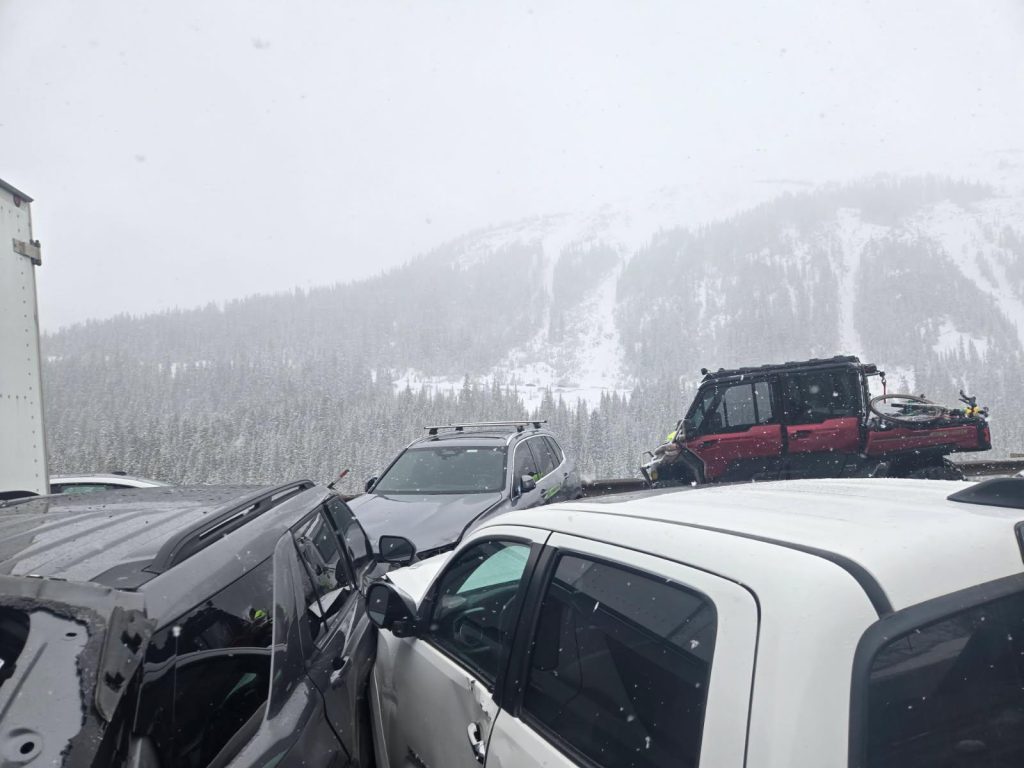
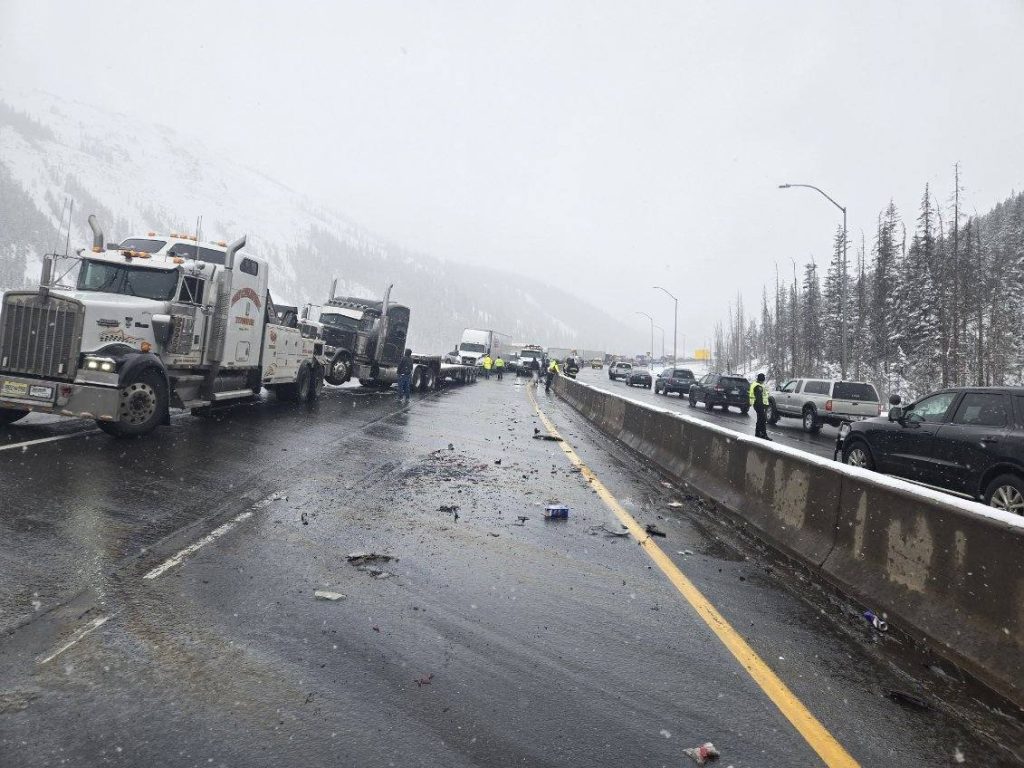
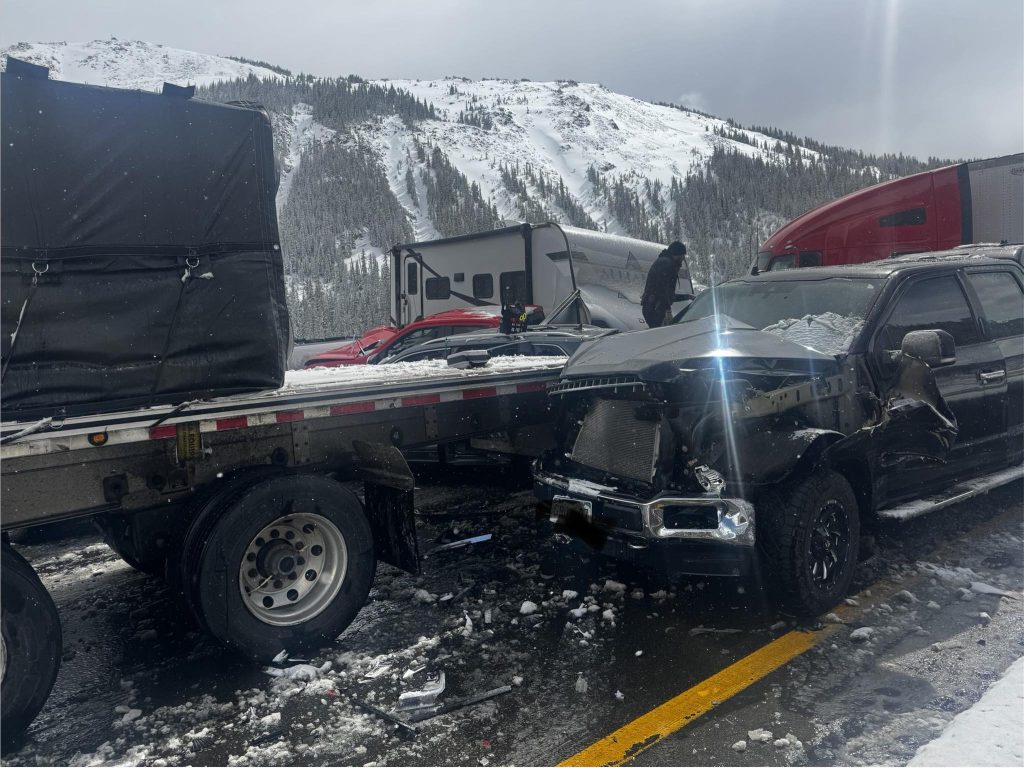
6:30 p.m.: Photos released by Colorado State Patrol show dozens of vehicles in a pile-up crash on Interstate 70 between the exit for Loveland Pass and the Eisenhower-Johnson Memorial Tunnels.

Eastbound I-70 drivers are being rerouted over Loveland Pass via U.S. Highway 6. Officials have not released an updated beyond the estimate for reopening happening between 8-10 p.m.

4:45 p.m.: Eastbound Interstate 70 is estimated to be closed for the next four to six hours, but one westbound lane has reopened while the left-most lane remains closed for medical staging following a multi-vehicle crash that occurred at 2:50 p.m. Tuesday, April 14, according to a Colorado State Patrol news release published at 4:48 p.m.

At least 19 people with various levels of injuries are being transported to a hospital, but no fatalities were reported. The Clear Creek Sheriff’s Office stated an estimated 75 vehicles were involved in the wreckage.

4:06 p.m.: On top of the full Interstate 70 closure near the Eisenhower-Johnson Memorial Tunnels, I-70 westbound is closed over Vail Pass for a crash.

4 p.m.: The Clear Creek Sheriff’s Office stated that the crash occurred on the on-ramp of eastbound Interstate 70, where traffic from U.S. Highway 6 merges into I-70. Deputies estimated more than 75 vehicles were involved, according to a social media post.

I-70 is still closed in both directions near mile marker 216 near the Eisenhower-Johnson Memorial Tunnels and is expected to be closed for “an extended period of time,” according to Colorado State Patrol.

Alternate routes are advised, and this story will be updated as more information is released.

3:50 p.m.: Both directions of travel on Interstate 70 near the Eisenhower-Johnson Memorial Tunnels are expected to be closed for “an extended period of time,” following a “large, multi-vehicle” crash, according to a Colorado State Patrol press release.

Alternative routes are advised.

The Clear Creek Sheriff’s Office estimated that more than 75 vehicles were involved in the crash that caused both directions of Interstate 70 to close for “an extended period of time,” according to the office’s social media post.
Clear Creek Sheriff’s Office/Courtesy photo

3:20 p.m.: A multi-vehicle crash has closed eastbound Interstate 70 through Colorado’s mountains following a multi-vehicle crash, according to COtrip.org.

The crash comes following numerous closures on Interstate 70 and other highways during a snowstorm that has brought a few inches of accumulation to valleys and icy conditions on mountain passes. There are more chances for snow later this week.

Traction and chain laws are in effect. For more information, visit CODOT.gov/travel/winter-driving/tractionlaw.

For the latest weather alerts, visit Weather.gov/bou. For traffic alerts and road conditions, visit COtrip.org.

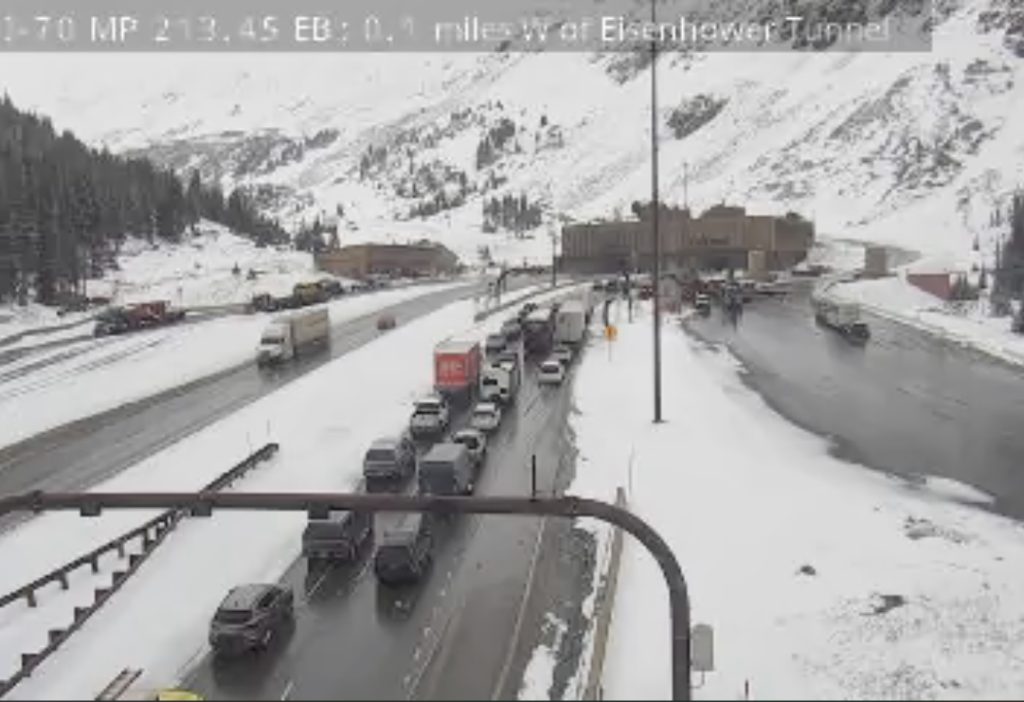
Traffic backs up at the Eisenhower-Johnson Memorial Tunnels on April 14, 2026 following a multi-vehicle crash.
Colorado Department of Transportation/Courtesy photo