Colorado Democrats move to expand scope of ‘red flag’ law that lets judges temporarily remove guns
Senate Bill 4 would add entities like health care facilities and schools to the list of groups that can petition to remove someone’s access to firearms for up to one year. Republicans and gun rights groups are sharply opposed to the measure.

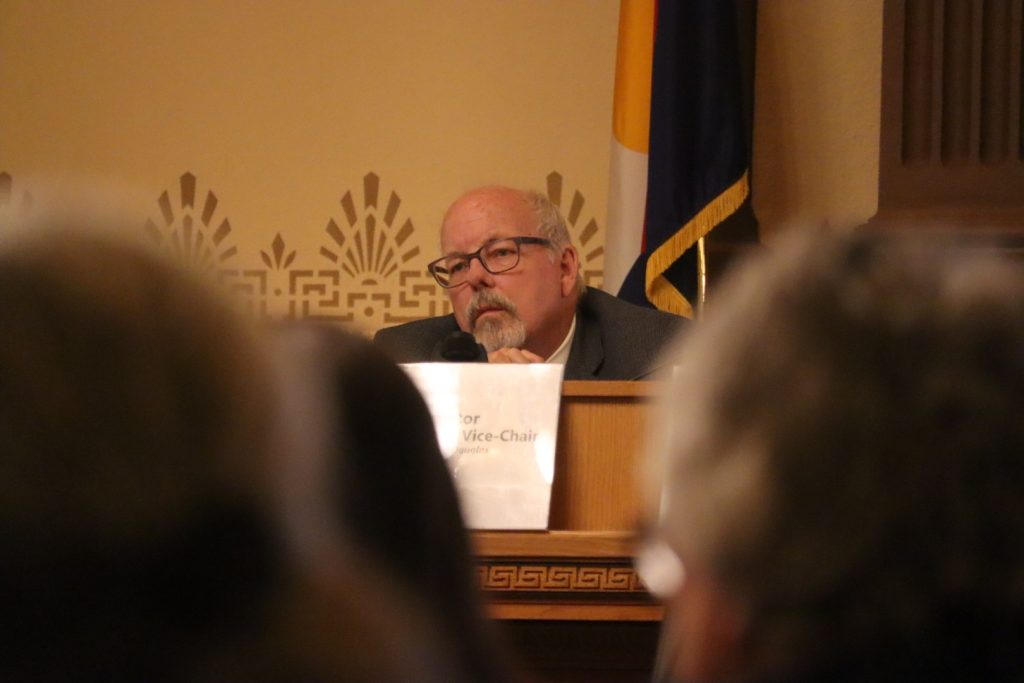
Robert Tann/Summit Daily News
Colorado Democrats want to give more groups the ability to petition a state judge to temporarily remove a person’s access to firearms, under a bill being considered this legislative session.
Senate Bill 4 would expand the scope of the state’s Extreme Risk Protection Order, or “red flag” law, by adding entities like health care facilities, behavioral health treatment facilities, K-12 schools and higher education institutions to the list of groups that can file a petition for firearm removal.
The bill is sponsored by Sen. Tom Sullivan, D-Centennial, and Rep. Meg Froelich, D-Denver. It received initial approval by Democrats on the Senate State, Veterans and Military Affairs Committee in a 3-2 party-line vote on Tuesday.
Sullivan, whose son Alex was killed in the 2012 Aurora theater shooting, has championed gun control measures during his time in the legislature. He sponsored the original red flag law in 2019 and led a bill last year that created a training and permit program for people who want to purchase most semi-automatic guns.
“The public health crisis that is gun violence isn’t something that can be addressed in just a singular policy attempt,” Sullivan said during Tuesday’s committee hearing on SB 4.
He asked lawmakers to support an expansion of the state’s red flag law to “continue to make Colorado a safer place to live.”
When Colorado’s red flag law first went into effect in 2020, it gave family members, teachers and certain health care professionals the ability to petition a judge to remove someone’s access to firearms for up to one year if they believe that person poses a threat to themselves or others. The measure was updated in 2023 to give petitioning ability to teachers and healthcare professionals, like doctors.
SB 4 further widens the scope by adding entities, rather than individuals, to that list.
Republicans on the veterans and military affairs committee were uniformly opposed to SB 4, which they characterized as an infringement on Second Amendment rights that would do more to threaten law-abiding citizens than reduce gun violence.
Sen. Rod Pelton, R-Cheyenne Wells, also asked Sullivan what protections were in place for rural residents, particularly farmers and ranchers, who rely on firearms to protect their industry from wildlife.
“What happens to those individuals if someone accuses them?” Pelton said. “Just because they have a lot of guns doesn’t mean that they’re going to be a threat.”
Sullivan replied, “Just the ownership of a gun doesn’t make you a threat to the public. It’s the things that you say or do that do that.”
Republican lawmakers also voiced concern that there were no penalties in SB 4 for petitioners who may make false claims about a person to remove their access to guns.
Sullivan said incidents of unfounded claims haven’t been a major issue and that the current law has guardrails in place to allow courts to adjudicate claims properly.
State data shows that the majority of petitions filed are successful. Of the 692 petitions filed between 2020 and 2024, 478 were approved by a judge for up to two weeks, and 371 were approved for up to one year, according to the Colorado Office of Gun Violence Prevention.
Petitions from law enforcement have a much higher chance of approval, however. As of 2024, more than 80% of law enforcement petitions for a one-year firearm removal have been approved, compared to just 22% for non-law enforcement petitioners.
The 2023 law that expanded the list of eligible petitioners to include teachers and health care professionals didn’t lead to a significant increase in filings, data shows.
SB 4 is supported by education and children’s advocacy groups, as well as gun control proponents.
Former Democratic state Sen. Evie Hudak, who now serves in a leadership role for the nonprofit Colorado Congress of Parents and Teachers, a longstanding child advocacy organization, told lawmakers during Tuesday’s hearing, “We want our government leaders to acknowledge and address the problem with access to firearms.”
“For most of our current members, their children have only ever lived in the shadow of mass shootings and widespread gun violence,” Hudak said, adding that the current school year began with the September shooting at Evergreen High School that wounded two students before the gunman died by suicide. “We strongly believe that this bill will help keep our children safer.”
Gun rights groups are sharply opposed to the measure.
Rocky Mountain Gun Owners Executive Director Ian Escalante said the bill is “looking to make it easier to strip firearms away from Coloradans.”
He added that schools could be pressured to file petitions under a 2015 law that makes it easier to sue school districts if they fail to protect students from foreseeable harm.
“This will be egregiously abused,” Escalante said.
SB 4 now heads to a full Senate vote.











Support Local Journalism
Support Local Journalism
As a Summit Daily News reader, you make our work possible.
Summit Daily is embarking on a multiyear project to digitize its archives going back to 1989 and make them available to the public in partnership with the Colorado Historic Newspapers Collection. The full project is expected to cost about $165,000. All donations made in 2023 will go directly toward this project.
Every contribution, no matter the size, will make a difference.