Here’s how two of Colorado’s gray wolves died this year
The U.S. Fish and Wildlife Service completed investigations for two of this year’s mortalities — an April death in Rocky Mountain National Park and a May death in northwest Colorado

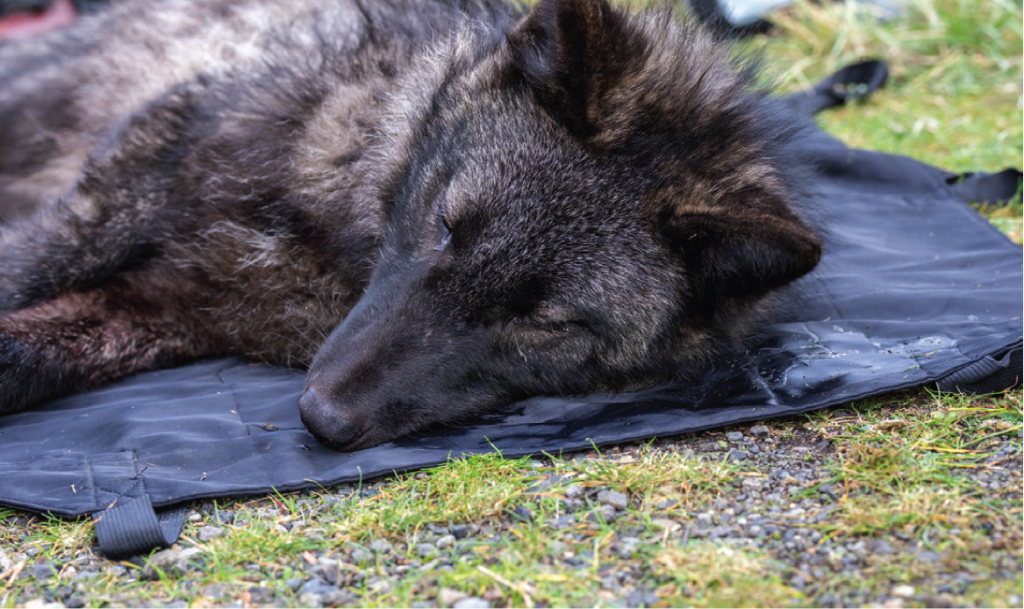
Colorado Parks and Wildlife/Courtesy Photo
The U.S. Fish and Wildlife Service has released the official cause of death for two of the British Columbia wolves that died in Colorado this year.
The federal agency reported that a mountain lion attack was responsible for the death of the female gray wolf, 2514, which died in Rocky Mountain Park on April 20.
Fish and Wildlife reported that the May 15 death of another female wolf, 2512, was related to “an apparent secondary trauma from a lawful foothold trap used for coyote control,” according to a press release from Colorado Parks and Wildlife. This wolf died somewhere in northwest Colorado.
Parks and Wildlife reported that the foothold trap was allowable under an exception, which enables properties with commercial livestock production to use the traps for 30 days. In this instance, the agency said a 30-day trapping permit was granted and that the trapper notified Parks and Wildlife when it trapped the wolf. The wildlife agency released the animal but reported it died the next day.
Because the trap was placed lawfully, no law enforcement action will be taken, Parks and Wildlife said. It has, however, implemented a “statewide suspension on its practice of issuing 30-day permits that allow taking coyotes or other terrestrial species using foothold/leghold traps, instant-kill body-gripping design traps, or snares and will provide additional guidance as soon as possible.”
The female wolves were two of six total gray wolf mortalities this year.
Two wolves were legally killed in Wyoming in March and April.
Gray wolves are currently federally listed under the Endangered Species Act in Colorado. As such, when a wolf dies in the state, the necropsy and investigation into the death are performed by the U.S. Fish and Wildlife Service. Initial results from necropies have taken anywhere from 1 month to 4 months to be released by the federal agency.
April 18, 2024: The U.S. Fish and Wildlife Service confirmed the death of a male wolf in Larimer County. Initial necropsy results from the federal agency, released in May, indicated that a mountain lion attack was likely the cause of death.
Sept. 3, 2024: Four days after being captured and placed in captivity, the Copper Creek pack’s adult male wolf died from injuries sustained in the wild. The wolf was reported to be underweight, have wounds on its right hind leg as well as an infection related to the injury.
In January, Fish and Wildlife released the initial necropsy results, reporting that a gunshot wound was responsible for the wolf’s “poor condition” and death. As it is illegal to kill or harm a wolf in Colorado, the death is still under investigation by the federal agency.
Sept. 9, 2024: A male wolf died in Grand County. In November, the Fish and Wildlife Service reported that the initial necropsy results suggest the death was likely due to a fight with another wolf. The report also showed that the wolf had an old, healed gunshot wound.
March 16, 2025: A male wolf was killed by the U.S. Wildlife Services in north-central Wyoming. The wolf was killed by the federal agency after it was tied to the death of five sheep.
April 9, 2025: A male wolf was killed in Wyoming, where the species is delisted from the federal Endangered Species Act and state law allows anyone to kill a wolf in the majority of Wyoming without a license.
April 20, 2025: A female gray wolf died in Rocky Mountain National Park from a mountain lion attack.
May 15, 2025: A female gray wolf died in northwest Colorado. due to “an apparent secondary trauma from a lawful foothold trap used for coyote control,” according to an investigation.
May 29, 2025: Parks and Wildlife killed one of the male yearlings in the Copper Creek Pack in Pitkin County. The lethal action was taken after the pack was connected to multiple livestock attacks in the area over Memorial Day weekend, meeting the agency’s definition for “chronic depredation.”
May 31, 2025: A male gray wolf died in northwest Colorado, likely from a collision with a car.
July 24, 2025: A female gray wolf died after traveling to Wyoming, the third to die in the neighboring state.
Aug. 16, 2025: A male uncollared wolf that was chronically depredating in Rio Blanco County was shot, but officials could not confirm if the animal died.
Oct. 30, 2025: A female wolf that was brought from British Columbia died in southwest Colorado. The cause of death is under investigation.
Parks and Wildlife killed one of the male yearlings in the Copper Creek Pack in Pitkin County. The lethal action was taken after the pack was connected to multiple livestock attacks in the area over Memorial Day weekend, meeting the agency’s definition for “chronic depredation.”
The federal agency is still investigating the death of a male wolf in northwest Colorado on May 31.
Fish and Wildlife Service will perform all wolf necropsies for those that die in Colorado as long as gray wolves remain federally listed as endangered in the state.
Even with the six mortalities this year, Parks and Wildlife has reported that wolf survival and mortality remain within a normal threshold in Colorado for the establishing population.




Support Local Journalism
Support Local Journalism
As a Summit Daily News reader, you make our work possible.
Summit Daily is embarking on a multiyear project to digitize its archives going back to 1989 and make them available to the public in partnership with the Colorado Historic Newspapers Collection. The full project is expected to cost about $165,000. All donations made in 2023 will go directly toward this project.
Every contribution, no matter the size, will make a difference.