Dillon plans for the next 90 days and beyond after reviewing community forum feedback

Kyle McCabe/Summit Daily News
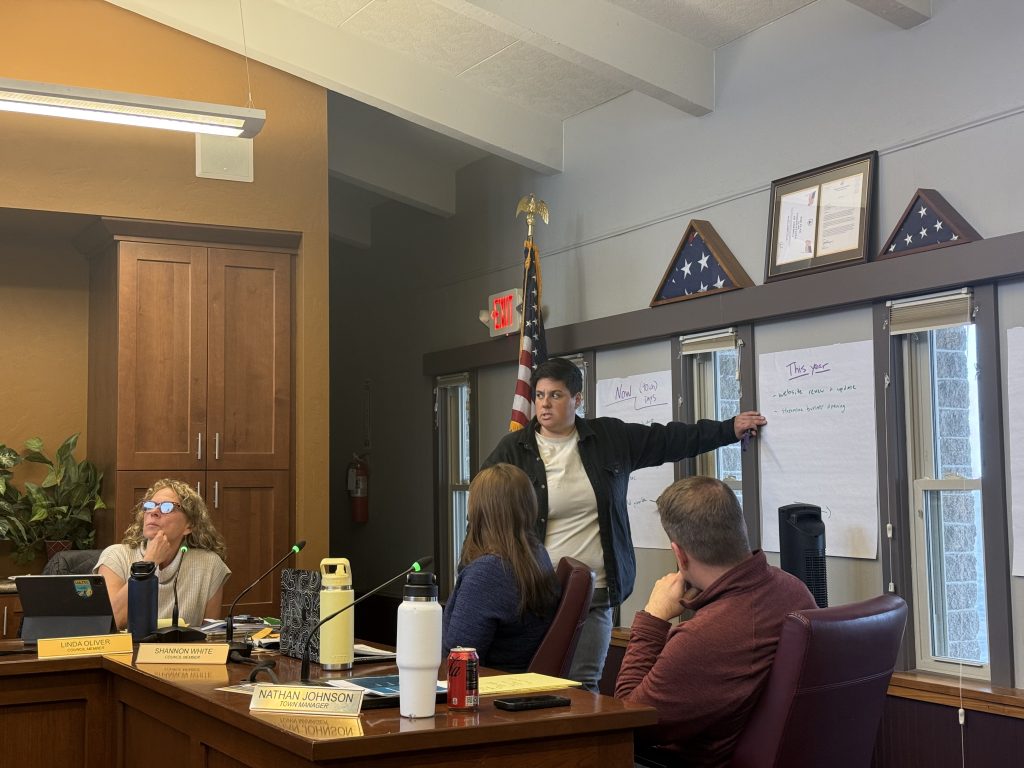
The Keystone Policy Center presented at a Dillon Town Council meeting for the second week in a row as the town looks to turn input gathered at a series of community meetings focused on redevelopment into action.
Trace Faust, a senior program director with the center, helped lead the community forums and is helping the Town Council create a strategic plan based on the feedback gathered. Faust led a conversation Tuesday, May 5, that focused on organizing priorities the council identified in its last meeting into things the town can accomplish in the next 90 days, in the next year and in the long term.
“I don’t want you to talk about the ‘how’ yet,” Faust said. “We’re just talking about the ‘what.'”
The group first discussed items that fell under the category of economic development, which included food trucks and pop-up activations; streamlining the business-opening process; business visibility and marketing; cross-community learning; empowering the town’s Economic Development Advisory Committee; and connecting building owners to businesses.
The Town Council also talked about items in the planning and connectivity category, which included wayfinding and signage; walkability and connectivity; town codes and design standards; connectivity across U.S. Highway 6; and placemaking and public spaces.
Faust had the group place those priorities in the different “buckets” of when they could be addressed and talk about who would “own” each item that was placed in the 90-day category.
The 90-day priorities included food trucks and pop-up activations, which aim to take advantage of times when lots of people are in town for events like amphitheater concerts. Mayor Joshua Samuel said that the council and town staff will have to work on that item, with the “owners” being himself, mayor pro tem Barbara Richard and town manager Nathan Johnson.
Faust asked if the town has some sort of summer kickoff event with food trucks, and when council members said that it does not, she suggested having an event like that as part of the short-term effort to build community connection through pop-up events.
Another 90-day item was the idea to connect building owners to businesses. The Town Council talked about having town staff do an audit of available commercial space in the town so potential business owners could learn from the town what opportunities may exist.
A conversation about design standards also landed in the 90-day bucket. Faust said town staff would own this item, as it needs to prepare a presentation for a future Town Council meeting. Senior town planner Ned West said staff has already started working on such a presentation.
Cross-community learning will involve the town reaching out to other municipalities to learn about ways they have successfully redeveloped or revitalized downtown areas. Samuel said he learned about Longmont’s downtown development agreement, which he has previously suggested the town learn more about, at a Colorado Municipal League conference. Faust said the cross-community learning in the next 90 days will include this year’s conference but could also include Dillon inviting representatives from other towns to present at meetings or having council members take “field trips” to other towns to learn about their programs.
Empowering the Economic Development Advisory Committee, Faust said, will start with the Town Council clarifying the committee’s role and giving them a few priorities to work on. She said the council, therefore, has ownership of the item, although staff has a role to play in making sure the conversation is included on a future meeting agenda.
The conversations about town codes that the Town Council had identified as a priority could start in the next 90 days, the council decided, specifically with a review of town code as it relates to wayfinding and signage. West said he can prepare a review of town code for any specific topic, like wayfinding and signage, in the future if the council wants to look at other areas.
Related to walkability and connectivity, the Town Council put an update on street crossings on Highway 6 it hopes to get repainted by the Colorado Department of Transportation on its 90-day list. Public works director Scott O’Brien said he would have an update ready by the next Town Council meeting.
The last 90-day priority was about placemaking and public spaces, which Faust said revolves around “activating the town core.” She asked if the council would want to have a conversation about one or two things it could do in the next 90 days “in the spirit of public spaces and placemaking,” which she said could include bringing food trucks into the town.
Richard said that people want gathering spaces but bringing people into those spaces requires programming, so she would like to talk about what sort of additional programming the town would have the capacity to handle over the summer. Samuel said the town has areas that would make good gathering areas and getting people to them might be a matter of letting them know they exist.
“There are now areas that are attractive to sit and maybe congregate and socialize, but they have to be promoted,” Samuel said.
Faust ended her time with the council by asking how it wanted to communicate the work it had done at the meeting to the community. She suggested she work with Johnson to lay out a 90-day action plan for the town share with the community through emails, coffee with council events or other channels.
“Just so that folks kind of feel there’s a little momentum,” Faust said. “In 90 days, we’re going to be a few more clicks ahead on some really concrete things than you were when we started this.”





Support Local Journalism
Support Local Journalism
As a Summit Daily News reader, you make our work possible.
Summit Daily is embarking on a multiyear project to digitize its archives going back to 1989 and make them available to the public in partnership with the Colorado Historic Newspapers Collection. The full project is expected to cost about $165,000. All donations made in 2023 will go directly toward this project.
Every contribution, no matter the size, will make a difference.