Dillon Town Council shows support for summer water restrictions
Town staff recommended mandatory restrictions to ensure water system reliability

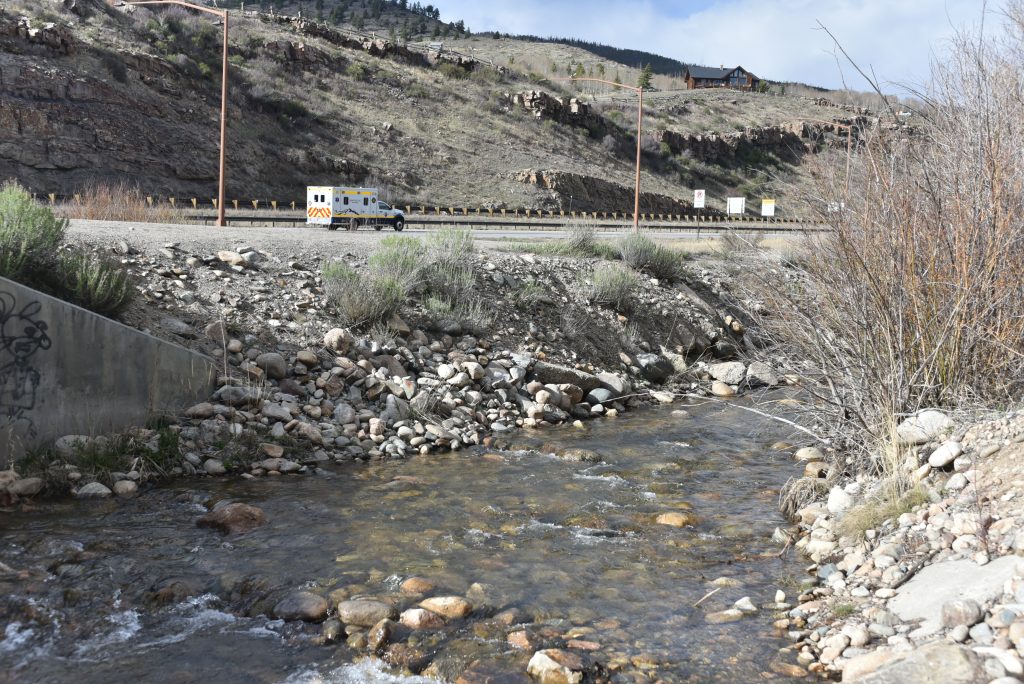
Kyle McCabe/Summit Daily News
At its April 14 work session, the Dillon Town Council directed town staff to draft a resolution to restrict outdoor watering in the town to two days per week starting May 1.
Town staff presented to the council about the outlook of the town’s main water source, Straight Creek, and, based on the outlook, recommended the council implement either two-day or three-day watering restrictions. The restrictions will allow residents to water their lawns overnight on certain days, depending on their home addresses being even or odd.
Public works director Scott O’Brien said the outlook for the Upper Colorado River Basin, in which Summit County is located, is below average. He said the messaging he has heard from experts has encouraged water conservation for everyone the Colorado River serves.
“Every town, every community, every state, every water district, all of us along the Colorado River need to do everything that we can to conserve water and leave as much water in the river as we can,” O’Brien said. “There’s probably not enough to go around.”
Mark Helman, the town’s utilities superintendent, said Straight Creek historically has “pretty good” water levels, which normally peak in late May or early June. The water level does not fall off too much from that peak throughout the summer, he said, until late August or early September.
“What we’re seeing this year is it’s peaking right now,” Helman said.
An early flow peak in Straight Creek likely means it will deplete faster, Helman said. The flows in June and July this year may be closer to what the stream usually has in August and September, he added, which could be a “huge problem.” The town pulls more water during the summer than it does any other time of the year, he said.
O’Brien said town staff recommended restrictions because it thinks they will be needed to meet domestic and irrigation water use demands this summer. Domestic water use includes any normal in-home uses, like drinking water, he added.
There is a “good chance” Straight Creek’s flow will drop below 2 cubic feet per second at the diversion point where Dillon pulls water from the creek, O’Brien said. If that happens, town code would require a ban on outdoor water use.
“We’re in uncharted territory,” O’Brien said. “Meeting the domestic demand for the community is going to be a challenge, and we’re not gonna be able to do it without restrictions and possibly a ban.”
The last time Dillon enacted outdoor water restrictions was 2002, according to a staff report. O’Brien said outdoor watering was limited to three days a week. Helman said that the flow levels so far this spring have been similar to those to 2002, but a graph in the staff report showed levels in 2002 did not peak until early June.
“The graph kind of tells it all,” Helman said. “Unless we get some drastic weather changes, we’re going to be much worse off than 2002.”
Helman said another motivation to curb water demand is that doing so will allow Dillon’s water plant to run as efficiently as possible and fill up its storage tanks as often as possible. Filled tanks allow the plant to shut off overnight, when demand drops, and start up the next day, he said.
If the tanks do not fill like usual, Helman said, it also creates issues for fire protection. The plant is supposed to keep its tanks half full for the purpose of fire protection, he said. Any time levels drop below 50%, the town notifies the fire district and they mobilize equipment to try to counteract the lack of water.
“If our storage tanks are depleted continually and we’re rubbing that 50% capacity or possibly going below it, and then above it and then below it, we’re losing fire protection for the town,” Helman said. “Which is a big deal.”
Helman spoke about the pros and cons of doing three-day or two-day water restrictions, saying three-day watering will allow residents’ lawns to look better but also stresses the water system more than two-day restrictions. Conversely, two-day watering is worse for lawns, he said, but puts less stress on the water system. Helman added that two-day restrictions allow for more consistent messaging, as Denver Water and Breckenridge will have similar restrictions this summer.
“People coming up from Denver are going to be used to seeing that two-day-a-week message,” Helman said. “I think it’d be really easy, just to do two-day.”
O’Brien said the resolution for implementing two-day restrictions will come before the Town Council at its next meeting. The council’s schedule includes a special meeting Tuesday, April 28.





Support Local Journalism
Support Local Journalism
As a Summit Daily News reader, you make our work possible.
Summit Daily is embarking on a multiyear project to digitize its archives going back to 1989 and make them available to the public in partnership with the Colorado Historic Newspapers Collection. The full project is expected to cost about $165,000. All donations made in 2023 will go directly toward this project.
Every contribution, no matter the size, will make a difference.