More traffic impacts expected on I-70 next year as $700 million Floyd Hill project wraps up its first construction season
The major construction project along Colorado's Interstate 70 mountain corridor aims to relieve congestion and improve safety for drivers


Colorado Department of Transportation/Courtesy photo
After construction began on the Interstate 70 Floyd Hill project this summer, the Colorado Department of Transportation announced that ample progress has been made on the $700 million project, according to a Dec. 27 news release from the transportation department.
The multiyear infrastructure project focuses on an 8-mile stretch of the interstate between Evergreen and eastern Idaho Springs.
Construction on the east section of the project — from County Road 65 to the bottom of Floyd Hill — began in July and is expected to last until summer of 2026, according to the CDOT website. Traffic impacts are expected next year.
In 2023, crews focused on rock scaling and rock blasting to widen I-70 as well as drainage work and building retaining walls, the news release states. There were 66 traffic holds on I-70 and U.S. Highway 40 to perform rock scaling and eight rock blasts, according to the transportation department.

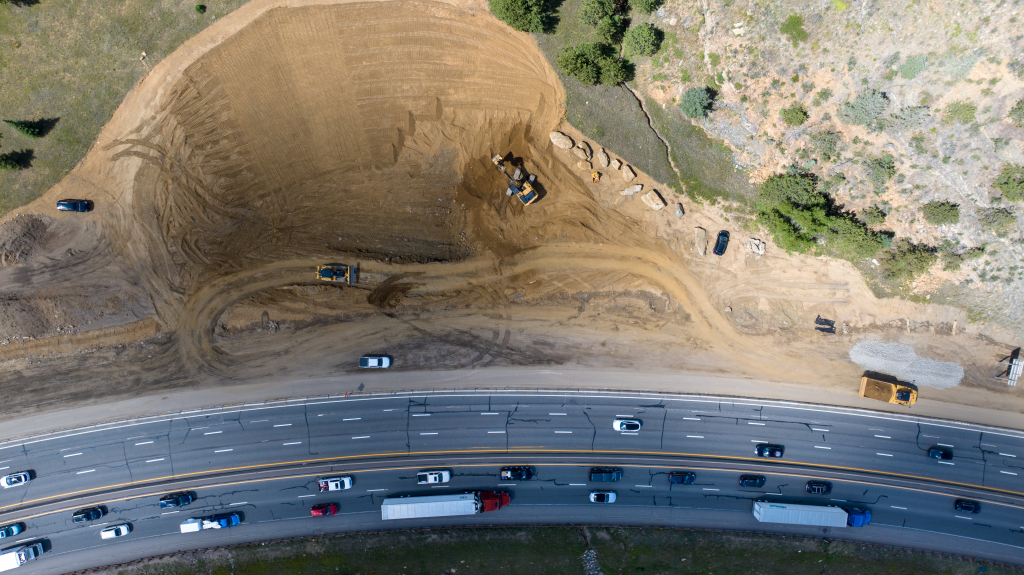
To widen the highway, 18,000 tons of material — the equivalent of 3,600 African elephants — was removed from the slope above eastbound I-70 along the east section of the project, where rock blasting is now 90% complete, the release states. Two additional rock blasts are reportedly anticipated for this area in January and early February.
Crews also installed 2,825 linear feet — the length of more than nine football fields — of drainage pipe and built retaining walls enforced with 20,000 square feet of shotcrete, the release states. Shotcrete helps maintain hillsides along the mountain corridor with a natural-looking finish, according to the transportation department.
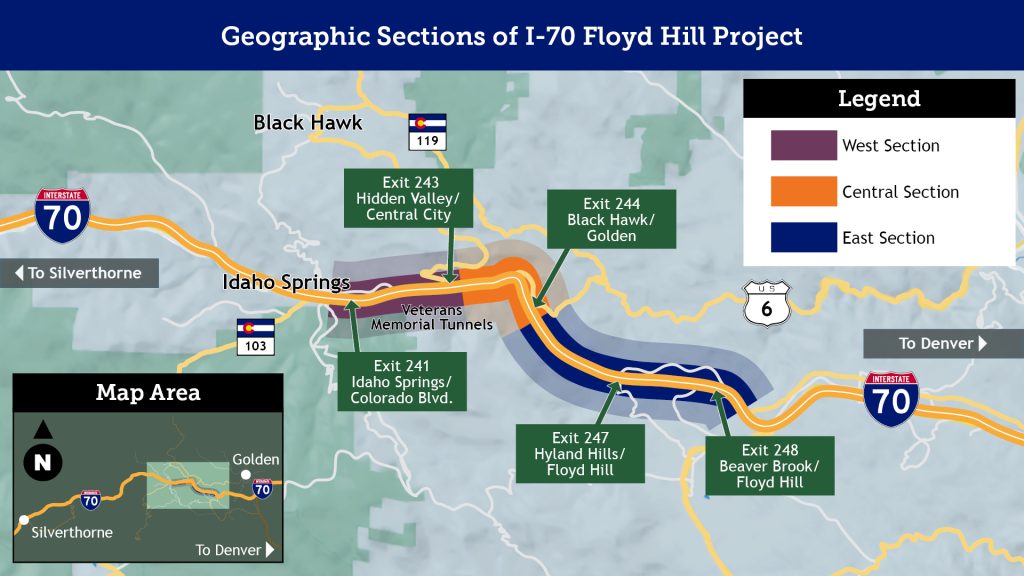
In late-fall, crews began preconstruction activities in the west and central sections of the project. To prepare for construction, crews in October reportedly relocated the I-70 Mountain Express Lane tolling infrastructure and began utility relocation and grading along the Clear Creek Greenway Trail, which requires a long-term closure of the trail.
Next year, work will continue on the east section of the project with construction activities expanding further west toward Idaho Springs. Early in the year, work will begin in the west section of the project, which spans I-70 from Exit 241 in Idaho Springs to Exit 243 at Hidden Valley, followed by work in the project’s central section, from about Exit 243 to the middle of Floyd Hill near Exit 244, according to the transportation department.
Drivers can expect overnight lane and ramp closures and intermittent daytime traffic holds for rock blasting and rock scaling, the release states. The best way to stay informed of traffic impacts is by signing up for project alerts by texting floydhill — one word, lowercase — to 21000.
The I-70 Floyd Hill project will add a third westbound I-70 travel lane — a full-time, tolled Express Lane from just west of Exit 247 through the Veterans Memorial Tunnels to Exit 241 at Idaho Springs — where a two-lane bottleneck now exists, according to the CDOT website.
The website also states that the project will rebuild bridges, improve traffic flow and access at interchanges and intersections, straighten roadway curves to improve sight distance and enhance wildlife connectivity, among other improvements.
Construction on the west section is expected to last until fall 2027, while construction in the central section is expected to last until the end of 2028.






Support Local Journalism
Support Local Journalism
As a Summit Daily News reader, you make our work possible.
Summit Daily is embarking on a multiyear project to digitize its archives going back to 1989 and make them available to the public in partnership with the Colorado Historic Newspapers Collection. The full project is expected to cost about $165,000. All donations made in 2023 will go directly toward this project.
Every contribution, no matter the size, will make a difference.