Roundabouts would be safer, ease traffic at intersections in Dillon on US Highway 6, engineers say

Kyle McCabe/Summit Daily News
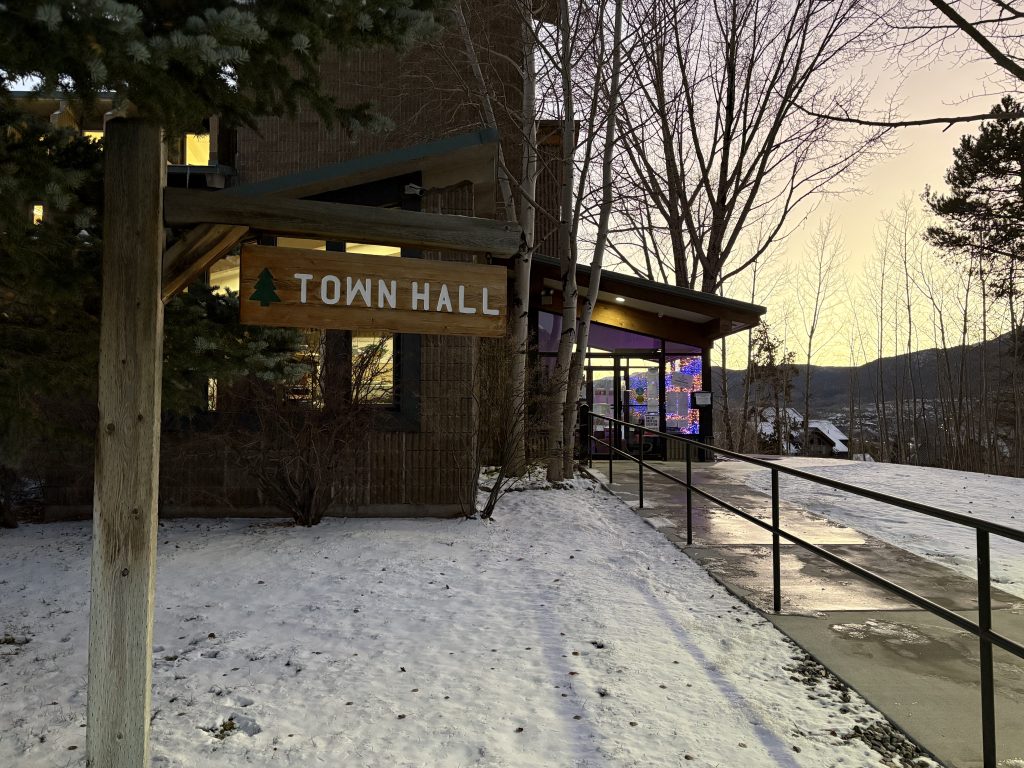
In October, the Dillon Town Council asked an engineering firm hired to work on a design for a roundabout at U.S. Highway 6 and Lake Dillon Drive to present alternatives first proposed in 2021.
Engineering firm Mead & Hunt presented four options for changes to U.S. Highway 6 near Dillon to the Town Council and Summit Board of County Commissioners in October 2021. The governing bodies pursued an option that includes building two roundabouts, one to replace the traffic light at the highway’s intersection with Lake Dillon Drive and the other farther east, connecting with County Road 51. They entered an intergovernmental agreement in 2024 that stipulated the county pay for the smaller roundabout and contribute funds to the larger one.
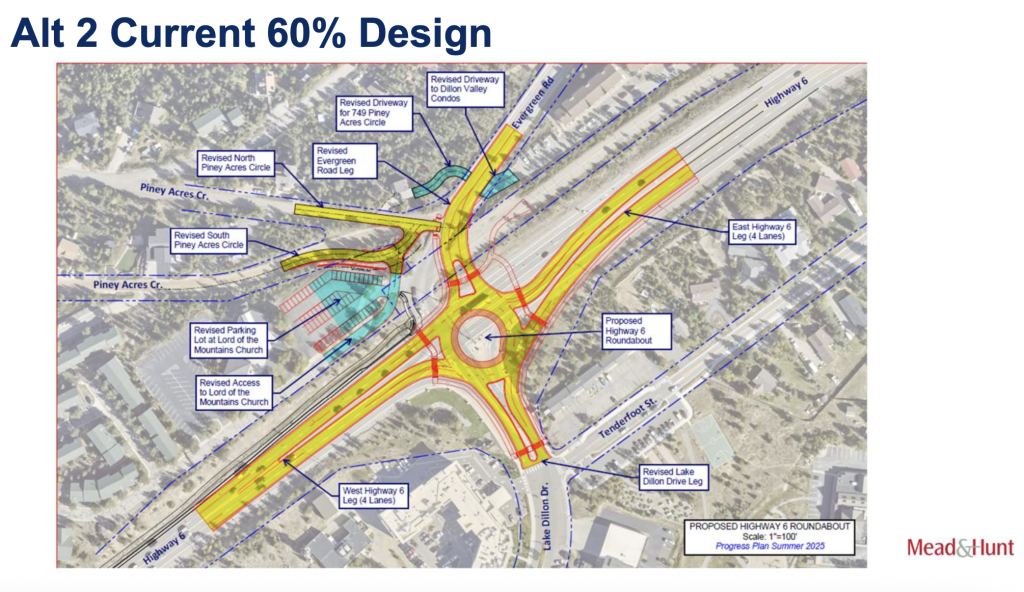
Mead & Hunt presented at an Oct. 14 Dillon work session, giving an update on the project’s progress. The council asked if the firm would review the original 2021 alternatives, and engineer Paul Silberman did that at the Jan. 20 work session.
Silberman explained that his firm had studied traffic volumes in the area and made future projections, taking into account future development that could include a workforce housing project on U.S. Forest Service land and new attractions in Dillon like a grocery store or restaurants.
That development could bring a 30-40% increase in traffic through the intersection of Highway 6 and Lake Dillon Drive, Silberman said.
“We definitely have some concerns about the ability of the signal to process all of that traffic,” Silberman said.
The options for roundabout construction included the double roundabout option; a variation of that option where the smaller roundabout would be built first and the traffic light at Lake Dillon Drive would remain as long as possible; putting one, even larger, roundabout at Lake Dillon Drive; and a variation of the one-roundabout option where it would not have bypass lanes.
Silberman said the firm explored other options early on, but they were all ruled out because the Colorado Department of Transportation would not approve them or the geometry was not feasible.
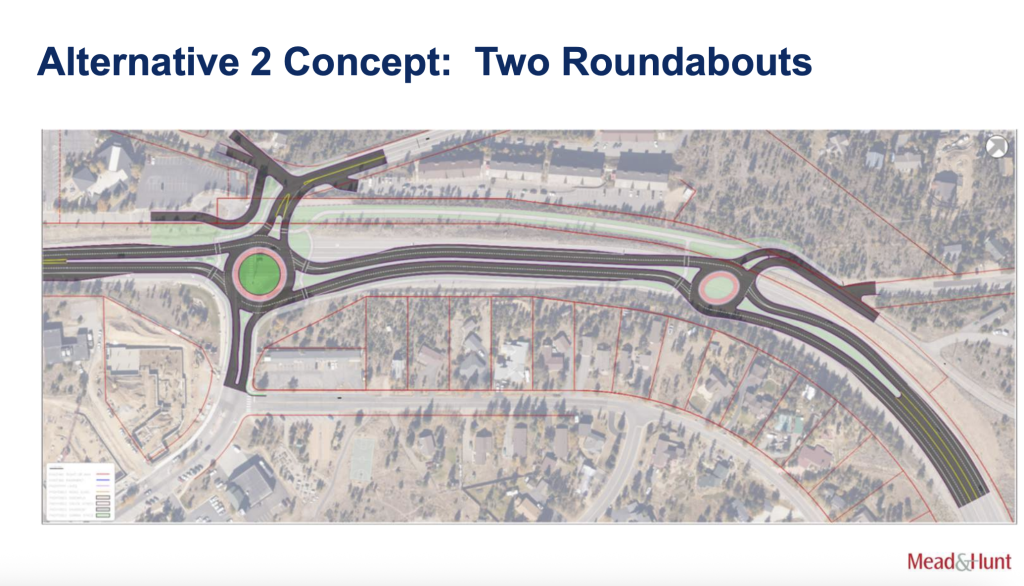
The firm suggested the two-roundabout option in 2021, Silberman said, and has been working on it since. He said that option would be more expensive than the one-roundabout option, but it also would have less impact on town right-of-way, residences and businesses, enhance traffic safety and multimodal accessibility and align with town and Colorado Department of Transportation long-term goals for traffic management and access on Highway 6.
Council members expressed concerns about the safety of a roundabout at Lake Dillon Drive. Mayor Carolyn Skowyra asked about the possibility of having a pedestrian underpass west of the intersection, and Silberman said an underpass could be an option, although roundabouts are already safer surface-level crossings than traffic lights.
“There’s only one conflict at each leg of the roundabout,” Silberman said. “Crash rates drop significantly … but even the crashes that do happen, because the speeds are so much lower, they’re much less serious.”
Silberman pointed out that roundabouts need to be designed well and force cars to turn as they approach in order to slow them down. Council members pointed to issues with roundabouts on Colorado Highway 9, and Silberman said the design of this roundabout would have up-to-date standards for “deflection,” or geometry that forces cars to slow down before entering a roundabout.
“We’re confident that this would be safer than what’s out there in some of these other roundabouts that you’re reading about,” Silberman said.
Skowyra also asked about any restrictions on what could go in the middle of the intersection to create a “gateway” to the town. Town engineer Dan Burroughs said he had conversations about that with the state transportation department, which advised it would want the town to put “an obstacle” in the middle so people would not drive through it.
“When you go towards Silverthorne, they don’t want it to look like the mountains in the background so you kind of drive through it,” Burroughs said. “They want it to be something that’s like, ‘Oh, I got to drive around that.'”
Skowyra asked if there were any options besides what had been presented. Silberman said there were no other viable options, adding that the Colorado Department of Transportation is supportive of roundabouts and is protective of Highway 6 because it is a hazmat route for Interstate 70.
“For an old signal that will have to be replaced, that isn’t as safe, doesn’t have the capacity you need, (the roundabout) is a really good solution,” Silberman said.
The council gave town staff direction to continue pursuing the two-roundabout option and look to study the feasibility of adding a pedestrian underpass to the project. They also directed staff to get more information about safety features and a preliminary design for the center of the roundabout.






Support Local Journalism
Support Local Journalism
As a Summit Daily News reader, you make our work possible.
Summit Daily is embarking on a multiyear project to digitize its archives going back to 1989 and make them available to the public in partnership with the Colorado Historic Newspapers Collection. The full project is expected to cost about $165,000. All donations made in 2023 will go directly toward this project.
Every contribution, no matter the size, will make a difference.