Thinking of hiking a Colorado 14er now that late-season snow is mostly gone? Here’s what to keep in mind.
The peak of 14er foot traffic usually begins to decline after mid-August. But there could still be weeks after that of ideal hiking conditions.

Robert Tann Follow

Antonio Olivero/Summit Daily News archive
The white summits of Colorado’s 14ers are continuing to diminish as summer temperatures bear down on the remnants of an above-average snow season. But while hiking may be more accessible, the state’s most iconic mountains may not see a rush of crowds.
“We’re starting to get to the point where use begins to ebb,” said Lloyd F. Athearn, executive director for the Colorado Fourteeners Initiative. “We had a really snowy start to the season … a lot of places really didn’t start to open up until July. I think we’re going to see an even smaller hiking season in 2023 than we did in 2022.”
A June 30 report by the initiative found the number of people climbing Colorado’s 14ers fell by 8% last year to about 279,000 hiker-use days — the second-lowest level recorded since the initiative began keeping statistics in 2014.
According to Athearn, 14er foot traffic usually peaks between mid-June and mid-August, with the return to school playing a large role in the decline in visitors after that.
“People will continue to hike the 14ers until mid-October,” Athearn said. “Usually by about that point, with shorter days and greater likelihood that you will have some level of snow cover on the trails, use has dropped off.”
It remains to be seen if this summer and fall will be different. Despite seeing a decline in visitors, September tends to be one of the better months for ideal 14er conditions, Athearn said. And many high-Alpine trails remained covered in snow until just weeks ago.
“A lot of trips people would typically plan in July couldn’t happen or at least couldn’t happen with the conditions they want,” said Anna DeBattiste, spokesperson for the Colorado Search & Rescue Association and the Summit County Rescue Group.
Never ask “What should we do this weekend?” again.
Get a weekly rundown of all the best happenings in Summit County sent to your inbox. Sign up here: SummitDaily/newsletter
Safety on the mountain
Summiting a 14er leaves hikers exposed to the elements. That’s why there are a slew of essentials to consider when taking one on.
Colorado’s 14ers range in difficulty from Class 1 to 5. Class 1, according to DeBattiste, usually means hiking on a well-defined trail. While hikes can be strenuous, the only skill this classification typically requires is moving uphill.
As the class increases, so do the skills needed to move up a trail. Classes 2 and 3 can include rocks and scrambles to reach the top, while 4 and 5 can require climbing gear.
DeBattiste said it’s important to know your skill level, especially if 14ers are a newer experience. And there’s no such thing as an easy hike on a 14er.
“When they say they are easy, they mean easy for a 14er. They are not easy,” she said.
Before beginning the ascent, DeBattiste said hikers should ensure they have the adequate gear they need including layers of clothing. Hyperthermia is still possible even in the summer, she said.
Hikers may think that “because it’s 70 degrees in Breckenridge that it’s going to be that at the top of Quandary,” she said. “In some extreme circumstances, it can literally be summer at the base and winter at the top.”
Hikers should bring plenty of water, at least 2 to 3 liters. Not drinking enough can lead to hydration which, when compounded with altitude sickness, can lead to potentially fatal outcomes.
If hikers begin to feel nausea, headaches or dizziness, it may be a sign of altitude sickness, DeBattiste said. The safest course of action is to descend and “understand the mountain will be there another day,” she said.
Hikers should also always be paying attention to the weather. Even though a forecast may show no signs of a storm, one can appear seemingly out of nowhere. Storms tend to move in from the west, so hikers coming from the east may have a harder time spotting dark clouds. In these instances, it’s important to listen for thunder, DeBattiste said.
“The best weather map is just your head on a swivel looking around,” said.
While it’s recommended hikers be off the mountain no later than noon, dangerous weather can happen at any time of the day. On June 30, the Summit rescue group responded to a call from two hikers frightened by lightning that struck the mountaintop before 9 a.m.
Hiking etiquette
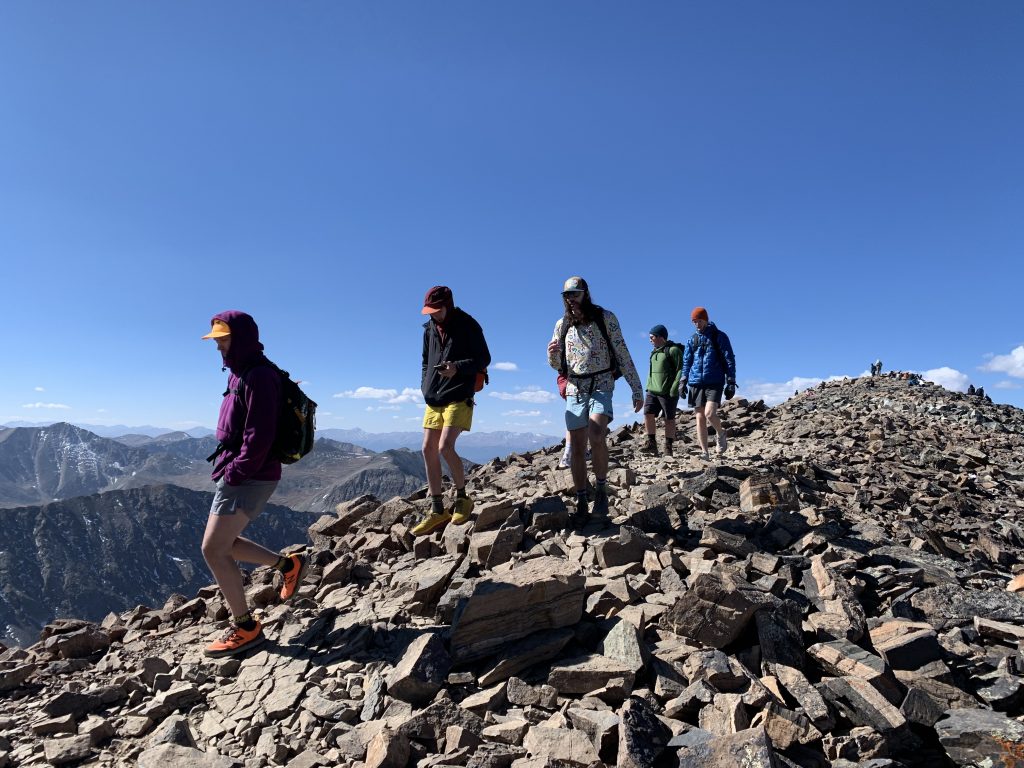
Athearn said oftentimes the top of a 14er can involve scrambling and advocated for sturdy hiking boots that offer ankle support and bottom grip.
Proper footwear can make the difference between finishing a hike and twisting an ankle which can spur a response from a rescue group. DeBattiste said the Summit rescue group has been responding to a high volume of calls related to twisted ankles and blown-out knees.
Waiting for help to arrive could take hours, DeBattiste said, especially since rescue teams must bring their own gear to ensure a successful recovery.
“If it took you four hours to get from the trailhead, you can count on it taking us longer than four hours to reach you,” she said.
At just above treeline, usually 2,000 to 3,000 feet from a 14er’s base, the Alpine tundra becomes increasingly fragile. Delicate wildflowers dot the landscape and it’s important hikers take note to stay on the main trail and avoid routes that may disrupt the ecosystem.
“The reality is many of these plants reproduce with flowers turning to seed and then the seeds dropping,” Athearn said.
If hikers pick or trample on these flowers, a flower can be killed before it releases seeds, therefore “short-circuiting that process,” he said.
Ground-dwelling mammals, such as pikas and marmots, also call this landscape home. For hikers taking their dogs, it’s important they keep them leashed, Athearn said.
It’s not unheard of that dogs, “while following their instincts, chase something that’s making noise and kill it or stress it out while it’s in the act of gathering food for the winter,” Athearn said.
All of this, Athearn said, is part of the “leave no trace” ethos that tries to ensure recreators cause little to no disturbance to the outdoors. The seven leave no trace principles are: Plan ahead and prepare; travel on durable surfaces; dispose of waste properly; leave what you find; minimize campfire impacts, respect wildlife and be considerate of other visitors.
Ultimately, good 14er etiquette is about keeping the mountains pristine and enjoyable for all, Athearn said.
“The 14ers are an international draw, they are mountains that people really come from very far distances to climb,” he said. “With these being popular mountains, everybody kind of needs to know how to share.”



Support Local Journalism
Support Local Journalism
As a Summit Daily News reader, you make our work possible.
Summit Daily is embarking on a multiyear project to digitize its archives going back to 1989 and make them available to the public in partnership with the Colorado Historic Newspapers Collection. The full project is expected to cost about $165,000. All donations made in 2023 will go directly toward this project.
Every contribution, no matter the size, will make a difference.