Democrats continue spending in House District 13 race amid lingering controversies over ‘dark money’ and transparency
The Democratic candidates also discussed concerns about their campaign that have been raised in public

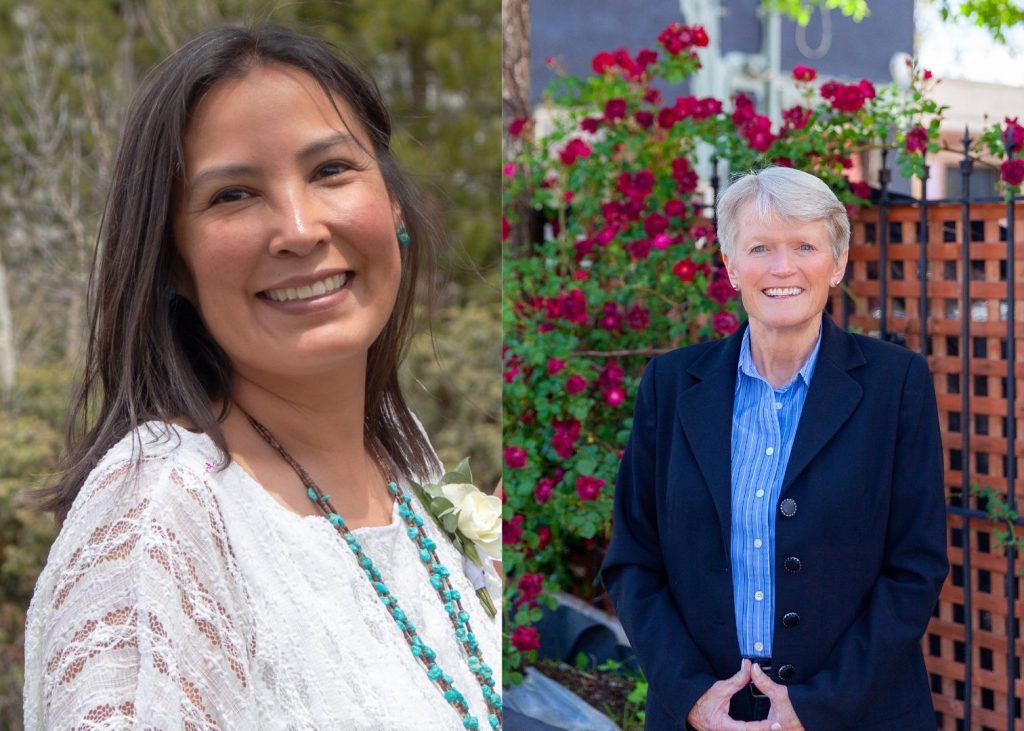
Courtesy photos
The race for the Colorado House District 13 is heating up as candidates face questions about campaign finance and ethics.
Consuelo Redhorse, the Summit School District Board of Education president, is running against Chris Floyd, a Leadville lawyer and former municipal court judge, in the June 30 Democratic primary. The winner of the race will take on Republican candidate Miguel Martinez in the November election.
House District 13 includes Summit, Grand, Park, Lake, Chaffee and Jackson counties. Voting by mail is already underway.
As the Democratic Party at the state level has grappled with issues of transparency and lobbying influence — the District 13 primary is facing similar issues. A group allied with Redhorse has accused Floyd of influence from “dark money” — a claim which Floyd denies.
Redhorse has also faced concerns about transparency during her time as president of the Summit School District Board of Education after a recording of a closed-door meeting was unintentionally released.
Meanwhile, Martinez — a former Lake County assessor who resigned after pleading guilty to a harassment charge involving other county officials — has raised various concerns about Floyd’s work as county attorney, which she called “frivolous.”
As voting kicks off in the primary race, here’s what voters should know about what funding is supporting each of the candidates’ campaigns and concerns raised about the candidates in public forums.
Small donations fund candidates’ official campaigns
Small individual donations between $5 and $450 are funding the Democratic candidates’ election committees.
Floyd’s campaign has raised nearly three times as much money — and spent about double — what Redhorse’s has, according to campaign finance reports filed with the Colorado Secretary of State’s Office. Both candidates filed their most recent report on June 1.
The Democratic candidates have scores of donations, the vast majority of which are from individual Colorado residents, according to campaign finance reports the candidates filed with the Colorado Secretary of State’s Office. Both filed their most recent report on June 1.
Floyd, who is backed by high-ranking Democrats including current District 13 Rep. and House Speaker Julie McCluskie, has received about $39,000 in campaign contributions and spent around $15,200.
Redhorse, who has been endorsed by progressive state lawmakers like Democratic Sen. Julie Gonzales, who is running against U.S. Sen. John Hickenlooper in the primary, has raised about $13,500 in campaign contributions and has spent around $7,800 on the campaign.
Both District 13 candidates have also received donations from “leadership funds,” or political action committees formed by state-level politicians.
Filings show that Floyd has received about $2,900 from political action committees associated with Reps. McCluskie, Meghan Lukens, D-Steamboat Springs, Sean Camacho, D-Denver, Andrew Boesenecker, D-Fort Collins, and Shannon Bird, D-Westminster, as well as Sens. Dylan Roberts, D-Frisco, and Lindsey Daugherty, D-Arvada.
Redhorse has received $750 from two political action committees, one associated with state Rep. Lorena Garcia and the other with state Sen. Janice Marchman, according to the reports. Filings also show she received a $1,000 donation from the COLOR Action Fund, which is affiliated with the nonprofit Colorado Organization for Latina Opportunity and Reproductive Rights.
Redhorse has donated roughly $5,300 to her own campaign, while Floyd has donated $1,000 to her own campaign, the reports state.
Redhorse has spent campaign funds on travel and advertising, including yard signs and buttons, according to the secretary of state’s office. Floyd has reportedly spent funds on advertising, including flyers and pamphlets, and professional consulting services.
‘Dark money’ spending on House District 13
Tens of thousands of dollars from special interest groups are flowing into the District 13 race, outpacing spending by the two candidates’ election committees.
Independent expenditure committees — groups that can advocate for the election or defeat of a candidate but are not supposed to coordinate directly with candidates’ campaigns — have spent
at least $60,000 on the District 13 race, according to filings with the Colorado Secretary of State’s Office.
That’s more than double what the official election committees for Floyd and Redhorse have spent to date, according to campaign finance reports — and it appears that some independent expenditure committees have not yet disclosed all of the funds spent in the race.
The COLOR Action Fund, which has donated to and endorsed Redhorse’s campaign, has posted social media ads describing Floyd as a “dark money candidate” who has received support from super PACs, or political action committees. Super PACs can raise unlimited amounts of money from donors, including corporations, and spend that money to advocate for or against candidates, but not directly fund the candidates’ campaigns.
Redhorse said that while she avoided raising the issue herself because she wants to lead a positive campaign, she has concerns about the large amounts of money being spent in the District 13 race.
“It should raise questions for voters, one about transparency, but two, how these groups — should my opponent get into office — influence her,” Redhorse said. “I think there’s this idea that these PACs will start asking for support on whatever issues because they helped get their candidate in office.”
Floyd said her filings with the Colorado Secretary of State’s Office outline what money her campaign has received, and that she can’t control any advertising that comes from other entities, like super PACs and independent expenditure committees.
“I don’t have any alliances with dark money, with folks that are doing all this stuff, that is out of my control and I have nothing to do with it,” Floyd said. “Blaming me for it is absolutely ridiculous.”
Floyd’s candidacy has been supported by several independent expenditure committees. Filings show a committee called American Future has spent about $15,600 to send out mail advertising with the message “Support Chris Floyd,” while another called Assuring Quality Healthcare Access for Colorado has spent $14,200 on “professional services supporting Chris Floyd,” according to filings with the Colorado Secretary of State’s Office.
Ads supporting Floyd have also stated that they are funded by Colorado Mountain Progressives and Colorado Affordability Project, but neither of those independent expenditure committees has filed disclosures with the Secretary of State outlining how much they’ve spent to support her.
Colorado Mountain Progressives has received donations from One Main Street, a nonprofit whose stated mission is to “rebuild Colorado’s middle class” and strengthen the state’s economy, and in the past has not disclosed its donors.
Registered agents listed with the Secretary of State’s Offices for the Colorado Mountain Progressives did not return requests for comment Wednesday seeking more information about what funding they receive and the issues they support.
A representative for American Future said the independent expenditure committee is associated with a super PAC to support sports betting. Assuring Quality Healthcare, which is associated with the medical liability insurance company COPIC, is funded by the company and advocates for legislation that allows for “healthy physician-patient relationships,” according to COPIC Senior Vice President of Public Affairs Beverly Razon.
Will Andras, the registered agent for the Colorado Affordability Project, said the committee supports candidates focused on affordability issues and has received funding from groups including the Colorado Association of Realtors.
Filings show Redhorse has had support from independent expenditure committees, but none that are associated with super PACs. The Voces Unidas Victory Fund, which spent $4,376 on telephone advertising with the message “Vote for Consuelo Redhorse. She will fight for all of us.”
The COLOR Victory Fund has spent a total of $35,500 on digital ads to support eight candidates seeking state offices, including Redhorse, according to campaign finance filings.
The Voces Unidas Victory Fund is associated with Voces Unidas, a Latino nonprofit based in Colorado’s central mountain region, while the COLOR Victory Fund is associated with the COLOR Action Fund, another Colorado-based nonprofit focused on reproductive justice and building Latino political power. Both are registered as 501(c)4 social advocacy groups, rather than political action committees, and follow different rules and disclosure requirements than PACs.
Redhorse said that she doesn’t consider this spending to be “dark money” because Voces Unidas and the COLOR Action Fund are community-based groups that provide clear information on the values they support.
Candidates address public concerns
In December, Redhorse faced backlash as the Summit School District Board of Education president after the accidental publication of a recording of a closed-door school board meeting. Experts who reviewed the recording said parts of the executive session violated the Colorado Open Meetings law around how personnel can be discussed during executive sessions.
Describing the situation as “really unprofessional,” Redhorse said in an interview that she regrets that “our walls were down a bit” and that board members used the opportunity to speak about matters outside the scope of an executive session, including about an incoming board member.
She said the board members “rely on each other to keep each other in line” and make sure they are following the Open Meetings law — but, in this case, “that’s something none of us did.”










Support Local Journalism
Support Local Journalism
As a Summit Daily News reader, you make our work possible.
Summit Daily is embarking on a multiyear project to digitize its archives going back to 1989 and make them available to the public in partnership with the Colorado Historic Newspapers Collection. The full project is expected to cost about $165,000. All donations made in 2023 will go directly toward this project.
Every contribution, no matter the size, will make a difference.