Wolf activity in January includes territorial movements as well as broad exploration in the southwest
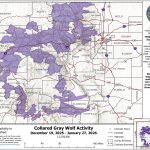
What Colorado Parks and Wildlife’s January wolf activity map shows

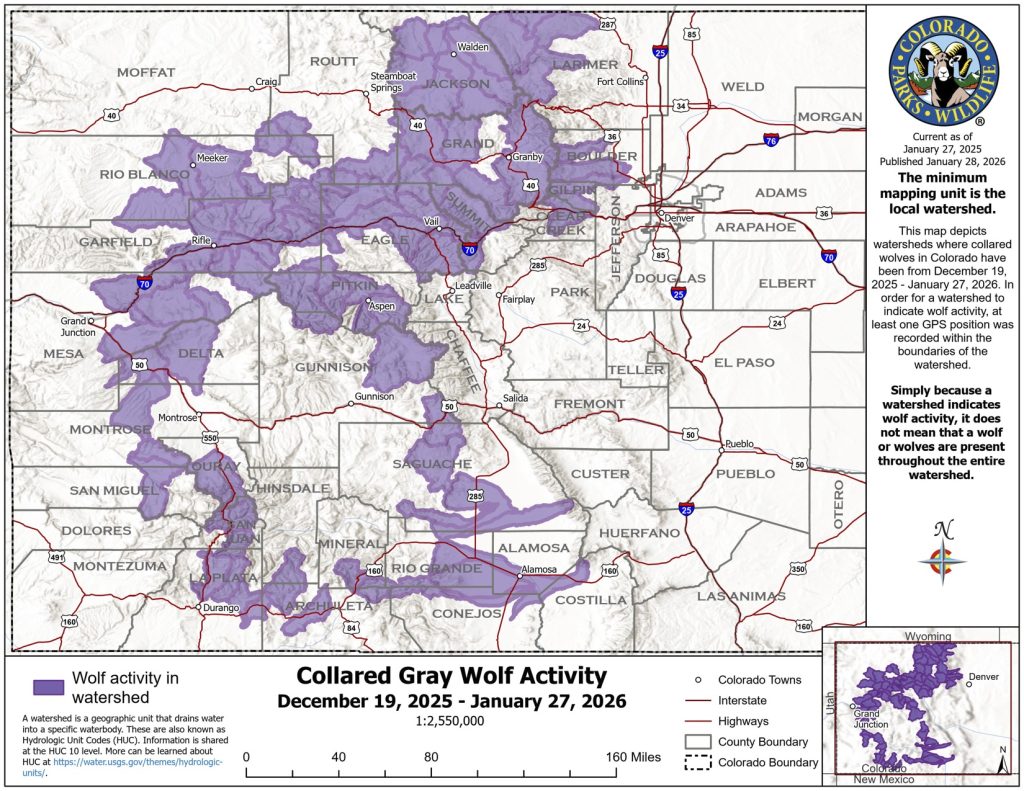
Colorado Parks and Wildlife/Courtesy graphic
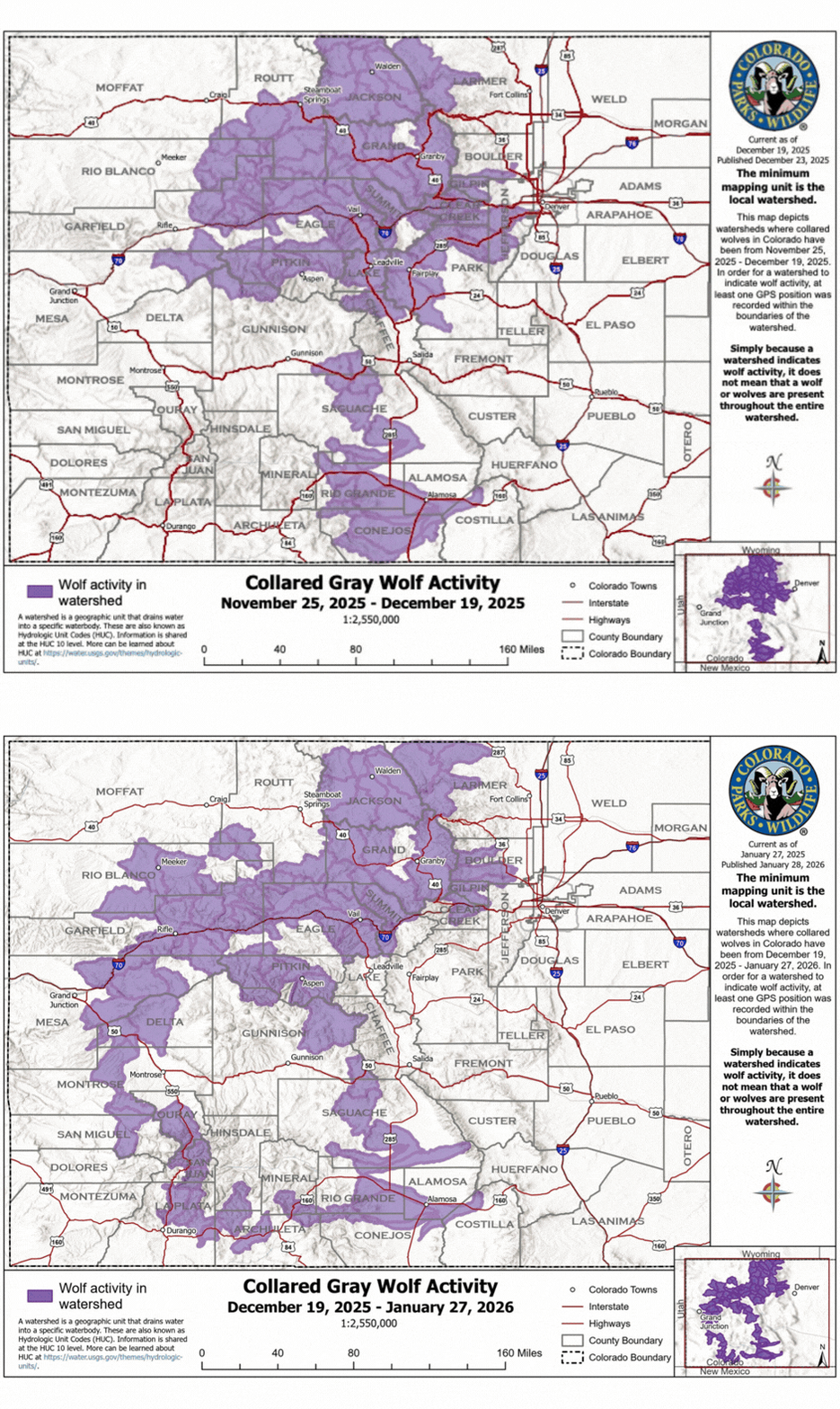
In the first two years of Colorado’s wolf restoration, some reintroduced wolves have begun to settle into the state’s northwest corner and establish territories. Others are continuing to make broad movements. In January, this exploration pushed further in the southwest, including near Colorado’s tribal lands.
Colorado Parks and Wildlife’s monthly wolf activity map shows the watersheds where the state’s collared gray wolves were located between Dec. 19 and Jan. 27.
Wolf activity persists in many northwest Colorado watersheds in Rio Blanco, Routt, Jackson, Grand, Summit, Eagle, Pitkin and Garfield counties. Colorado’s four established packs have set up in this region: the Copper Creek Pack in Pitkin County, the King Mountain Pack in Routt County, the One Ear Pack in Jackson County and the Three Creeks Pack in Rio Blanco County.
The January map also shows broader movements than the previous month throughout the southwest, with activity noted in watersheds crossing Mesa, Delta, Gunnison, Saguache, Rio Grande, Conejos, Archuleta, Hinsdale, San Juan, La Plata, San Miguel and Montrose counties.
Parks and Wildlife reported that “one wolf moved rapidly through several watersheds near tribal lands in Colorado,” adding that it “has consistently shown broad movement but has not localized in any particular region.”
While Parks and Wildlife has an agreement with the Southern Ute Indian Tribe to guide wolf activity and management in the tribe’s southwest lands, the state agency said it is still working to finalize a similar agreement with the Ute Mountain Ute Tribe. The agreements are meant to outline how the agencies will collaborate, communicate and share resources within reservations and the Brunot Treaty Area, which spans 3.7 million acres in the San Juan Mountains.
This type of broad movement is expected from lone wolves as they search for mates, food sources and quality habitat. At a Jan. 8 Joint Budget Committee meeting, Reid DeWalt, deputy director of Parks and Wildlife, told lawmakers that as these wolves settle down, movements will become more predictable.
“The program becomes much more predictable when wolves pair and they get into a den site. They will defend that den site and that territory, and they’ll stay put,” he said. “That makes the program much easier to implement. We can assign those range riders, put those nonlethal techniques (in place), and the predictability goes very high.”
Despite continued activity in watersheds brushing up to several Front Range counties, including Boulder and Larimer counties, in January, Parks and Wildlife maintains that “no wolves have crossed I-25 or spent time near urban centers.”
If a watershed is highlighted, it means that at least one GPS point from one wolf was recorded in that watershed during the 30 day period. GPS points are recorded roughly every four hours.
January brought significant news for Colorado’s burgeoning wolf population.
On Jan. 16, a female gray wolf died — the seventh wolf to die from the 15 brought from British Columbia in January 2025, and the 12th death overall in the state’s wolf program.
While the death is still under investigation by the U.S. Fish and Wildlife Service, Ray Aberle, Parks and Wildlife’s private lands program manager, told lawmakers at a SMART Act hearing for the Colorado Department of Natural Resources on Friday, Jan. 23, that the death occurred in Rio Blanco County.
These mortalities will become more impactful to the state’s wolf population following Parks and Wildlife’s January announcement that it would not release any more wolves this winter.
The decision followed federal interference in the program, which barred it from returning to British Columbia for more wolves this winter and left Parks and Wildlife with limited time to secure another source. The agency was unable to do so, forcing a pause in releases that producers, lawmakers and Western Slope communities have been requesting for years.
At the Jan. 8 legislative hearing, Laura Clellan, the acting director of Parks and Wildlife, told lawmakers, “there’s not a current census or full wolf counts in the state,” adding that a minimum count will come in its annual wolf report published each spring.
What is known is that of the 25 adult wolves that Parks and Wildlife released in the first two years of reintroduction, 14 are still alive. It is also possible that there are wolves that have entered the state naturally.
Of the five Copper Creek pups born in 2024, four are still alive. One was killed by Parks and Wildlife due to chronic depredation in May. A second of this litter was shot during an attempted lethal removal operation, but with the animal’s body never found, the state wildlife agency has not reported it as dead.
Of the four packs established in 2025, the agency released minimum pup counts for two: at least four in the King Mountain Pack and at least six in the One Ear Pack. A typical den contains four to six pups, but survival in the first year can be low.






Support Local Journalism
Support Local Journalism
As a Summit Daily News reader, you make our work possible.
Summit Daily is embarking on a multiyear project to digitize its archives going back to 1989 and make them available to the public in partnership with the Colorado Historic Newspapers Collection. The full project is expected to cost about $165,000. All donations made in 2023 will go directly toward this project.
Every contribution, no matter the size, will make a difference.