Polis, western governors launch task force to upgrade region’s power grid as part of energy ‘superabundance’ agenda
Governors want to reduce regulatory burdnens for new transmission lines, speed up development

Robert Tann Follow
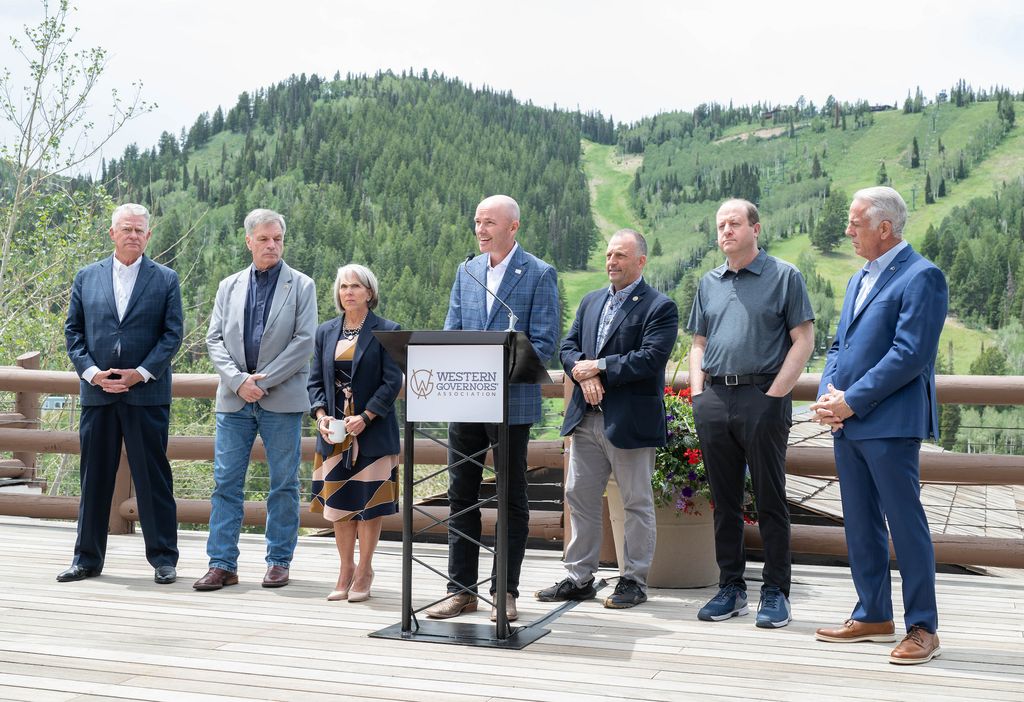
Western Governors’ Association/Courtesy photo
A bipartisan group of 11 western state governors say they are forming a task force to accelerate permitting and prioritize upgrades for the region’s energy grid.
Colorado Gov. Jared Polis joined the governors of Utah, Arizona, Wyoming, Nevada, Montana, Oregon, Washington, Idaho, North Dakota and New Mexico in announcing the plan during a meeting of the Western Governor’s Association in Deer Valley on June 30.
The task force is part of the group’s “energy superabundance” agenda, spearheaded by former Western Governors’ Association Chair and Utah Gov. Spencer Cox.
“Unfortunately, here in the West, like much of the country, our current power system was constructed over 60 years ago,” Cox said during a June 30 press conference with governors. “These transmission lines and systems are aging and expanding too slowly and inefficiently to meet the demands and goals of today.”
The task force’s core goal is to provide “governors, their staff and participating tribal governments with a mechanism to jointly accelerate transmission permitting, resolve cross-jurisdictional challenges, and elevate regional priorities,” according to a statement issued by the 11 governors.
That includes creating a dashboard to track permitting milestones for transmission lines, developing standardized state permitting schedules for high-priority regional and interstate projects, and coordinating with federal agencies, local governments and tribes.
Governors said they’ll be able to achieve these state-level actions without federal permitting reform. They also endorsed the Western Transmission Expansion Coalition, or WestTEC, which Cox described as an “industry-led effort that takes a new collaborative approach to one of our region’s most pressing infrastructure challenges.”
“This is the West working at our best, working together across party lines,” Cox said.
The announcement was followed by panel discussion with governors and energy industry leaders, who touched on energy development, emerging technologies and regulatory reform. Underpinning much of their discussion was the need for cheaper reliable energy.
Responding to a question from Polis about cost projections for geothermal projects, Ben Serrurier, director of government affairs for FERVO Energy, a Texas-based geothermal company, said standardizing industry practices is a key to lowering costs.
“Can we standardize the fuel source?” Serrurier said. “Basically, go to Colorado, go to Utah, go to Nevada, go to New Mexico, go to Wyoming … and know how far down you have to drill to hit a certain temperature. Know that we can engineer the reservoir to get a certain flow rate that’s commercial and integrate that right into an off-the-shelf standardized design generator.”
He continued, “If we can do that, then we’re really cranking these things out at low cost. And the question really becomes one of what’s the regulatory environment? What’s the permitting environment look like? … Those questions start determining how fast we can grow much more than the technical or geologic questions.”
In May, Polis joined the governors of Utah, Arizona and New Mexico to form a multistate coalition aimed at advocating for more geothermal energy development in the West.
“Ninety-five percent of America’s capacity for geothermal is located in the western states, and it’s underutilized,” Polis said during a virtual appearance at an event hosted by Cox in Salt Lake City. “It’s there, and it’s ready, and we want to pursue it.”
Cox added that by banding together, western states can have a greater voice at the federal level through their congressional delegation to advocate for geothermal projects and permitting reform.
Much of the land in the West is federally owned, meaning states that want to unlock more geothermal projects will likely need buy-in from the federal government. In Colorado, the federal government owns over a third of the state’s land.
Last week’s Western Governors’ Association also marked the last for Cox as the group’s chair. He is succeeded by Hawaii Gov. Josh Green, whose chair initiative, “health beyond healthcare,” will focus on ways to improve access to mental healthcare.






Support Local Journalism
Support Local Journalism
As a Summit Daily News reader, you make our work possible.
Summit Daily is embarking on a multiyear project to digitize its archives going back to 1989 and make them available to the public in partnership with the Colorado Historic Newspapers Collection. The full project is expected to cost about $165,000. All donations made in 2023 will go directly toward this project.
Every contribution, no matter the size, will make a difference.