‘Pretty concerning situation up here’: Denver Water gives update on Dillon Reservoir forecast

Ryan Spencer/Summit Daily News1
Representatives from Denver Water visited the Summit Board of County Commissioners on Friday, March 13, to give an update on Dillon Reservoir operations.
Nathan Elder, Denver Water’s water supply manager, said the conditions this year are “really poor,” with the amount of water in the snowpack sitting at 61% of normal. Since Denver Water started using its equipment measuring water in the snowpack in the late 1970s, Elder said, this year has the second lowest measurement.
“Pretty concerning situation up here,” Elder said.
Forecasts do not predict a “miracle March” either, Elder said, meaning Denver Water does not expect the poor snowpack situation to improve. The low amount of water in the snowpack translates to Denver Water expecting the Dillon Reservoir’s inflow to be around 55% of normal, Elder said, adding that it is possible that the reservoir sees its lowest inflow ever.
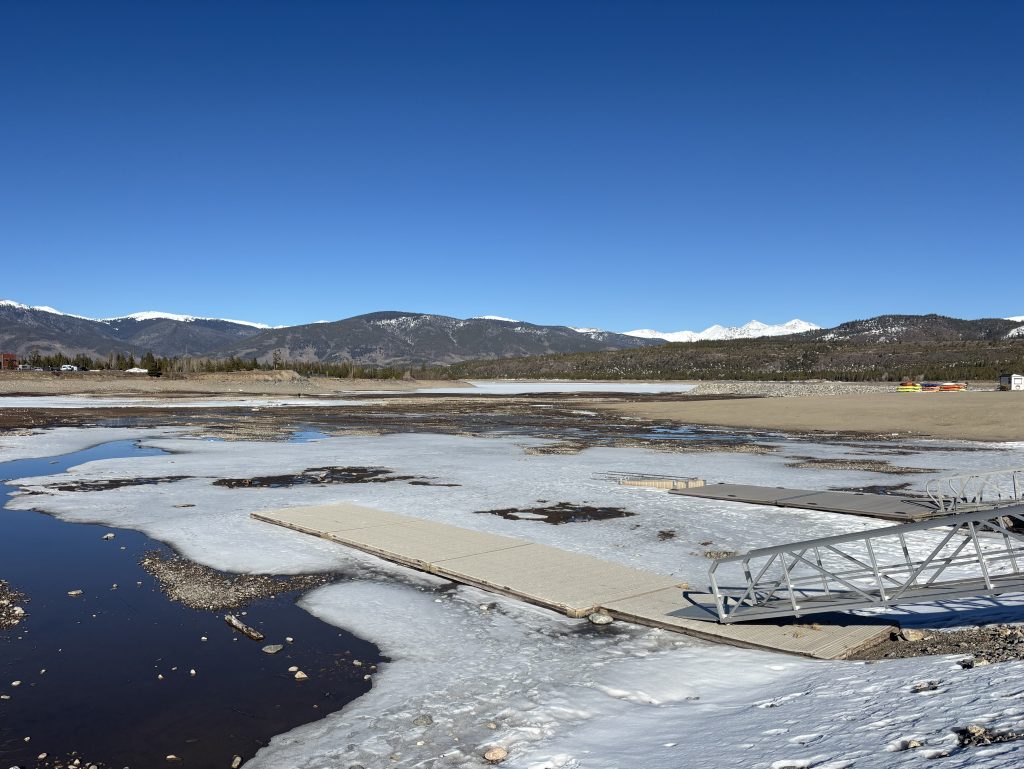
Elder showed high, middle and low forecasts for the reservoir’s storage level. He said the middle forecast is the most probable, and with that forecast, the reservoir would reach the level required to operate the Dillon Marina for several months but only reach the Frisco Marina’s operation level for a short time.
“Dillon, because that one goes deeper, (there’s a) higher probability of them being operational for more of the year,” Elder said. “But again, you know, not looking to have a full season this year.”
The low estimation would not see the reservoir reach either marina’s operational levels. The high estimation would have the reservoir go over both marina’s operation levels for at least part of the summer, without ever reaching average historical storage levels. The Frisco Marina has already announced a plan to close its boat ramp and slips and adjust operations due to low water levels.
Commissioner Eric Mamula asked if the amount of water Denver Water takes out of Dillon Reservoir is a set number or if it varies, and Elder said it varies based on conditions like weather and the state of other reservoirs in Denver Water’s system.
Stay connected to Summit County.
Sign up for daily or weekly newsletters at SummitDaily.com/newsletter
The marinas, according to commissioner Tamara Pogue, have a “significant” economic impact to the community. She asked Elder what sorts of water-use restrictions Denver Water will have on the Front Range, as they could help leave more water in the Dillon Reservoir and mitigate the negative economic impact on Summit County.
Elder said Denver Water will have restrictions this summer, and it plans to start them later in March.
Commissioner Nina Waters asked if Denver Water might be able to use more water from other reservoirs to mitigate the low-water season’s impact on Dillon Reservoir, considering it is home to two marinas.
Elder said Denver Water may empty other reservoirs in its system, depending on how dry the summer turns out to be. In response to Waters asking if Denver Water could release more water from Dillon Reservoir to Green Mountain Reservoir to support fishing and rafting on the Blue River, Elder said the water utility will try to keep as much water in Dillon Reservoir as possible.
“That’s going to help us for next year, to recover, to get out of this situation as soon as possible,” Elder said.
Denver Water is considering skipping its first level of water restrictions on the Front Range, Elder said, meaning they would immediately be mandatory instead of voluntary. Ashley Denault, a community relations specialist with Denver Water, said mandatory restrictions on outdoor watering can lead to a 20-30% reduction in water use.
Denault said the water utility has a higher level of restrictions at its disposal, which completely ban outdoor watering, but it has never used them before.
Before Elder and Denault left, Waters asked that Denver Water “be as strategic as they can” in managing its system to keep the Dillon Reservoir as full as it can.
“We’re coming off a really hard (winter) season to begin with,” Waters said. “Any impacts to Lake Dillon is really going to put us over the edge.”




Support Local Journalism
Support Local Journalism
As a Summit Daily News reader, you make our work possible.
Summit Daily is embarking on a multiyear project to digitize its archives going back to 1989 and make them available to the public in partnership with the Colorado Historic Newspapers Collection. The full project is expected to cost about $165,000. All donations made in 2023 will go directly toward this project.
Every contribution, no matter the size, will make a difference.