Summit School District administration, teachers union at odds over how much funding is available for salary increases
Amid negotiations, union leaders say the district is in better financial shape than it appears. Officials say the district's reality is more complicated.

Robert Tann Follow

Robert Tann/Summit Daily News
As salary negotiations continue between Summit School District leaders and members of the district’s teachers union, dueling narratives over the district’s financial situation have emerged.
Union leaders say the district is in better financial shape than what’s been projected in its 2024-25 school year budget, pointing to audit reports that show the district has ended previous school years with fund reserves higher than what was expected.
Negotiations hit an impasse last month, with union representatives rejecting an offer that they said would have meant an average salary increase of just 3%.
Union members and district leadership are now expected to enter closed-door discussions as early as next week, according to Liz Waddick, outgoing co-president for the union, which represents around 270 teachers.
With millions more dollars coming into the district’s general fund next school year following an infusion of cash by the state legislature, and with larger-than-expected reserves in recent years, Waddick says there’s no reason why district leaders can’t commit to higher salaries needed to meet the area’s high cost of living.
“We are told we are in deficit spending, the district has no money, that we are in dire straits. It’s very hard to believe,” said Waddick, a 17-year Summit High School Spanish teacher. “It’s no longer a story we are willing to listen to.”
Fund discrepancies
At the heart of the issue is the district’s reserves for the general fund, its largest account. Officials continue to raise concern over depleting the reserves, which is reflected in recent school year budget proposals.
For the 2021-22 school year, the reserve was budgeted to be $7.2 million, representing 13.8% of the overall general fund. In the 2022-23 budget, the reserve was expected to drop to 12.2% and in the 2023-24 budget it was expected to drop further to 11.5%. During those years, the district maintained a policy of keeping at least 7% in reserves on top of the 3% that is already mandated by state law for a total threshold of 10%.
However, audit reports show that the district’s reserve was greater than expected for both the 2021-22 and 2022-23 school year, which ended with reserves of 24% and 20.6%, respectively. A report has yet to be released for the 2023-24 school year.
Looking back as far as the 2015-16 school year, audits show that the district has seen anywhere from $2 million to $4.5 million more in its ending general fund balance than what was predicted.
“What it appears to be is that there is over budgeting, under spending and then the money goes to no one and instead gets allocated to the (reserve),” Waddick said. “That’s the consistent story of what we see.”
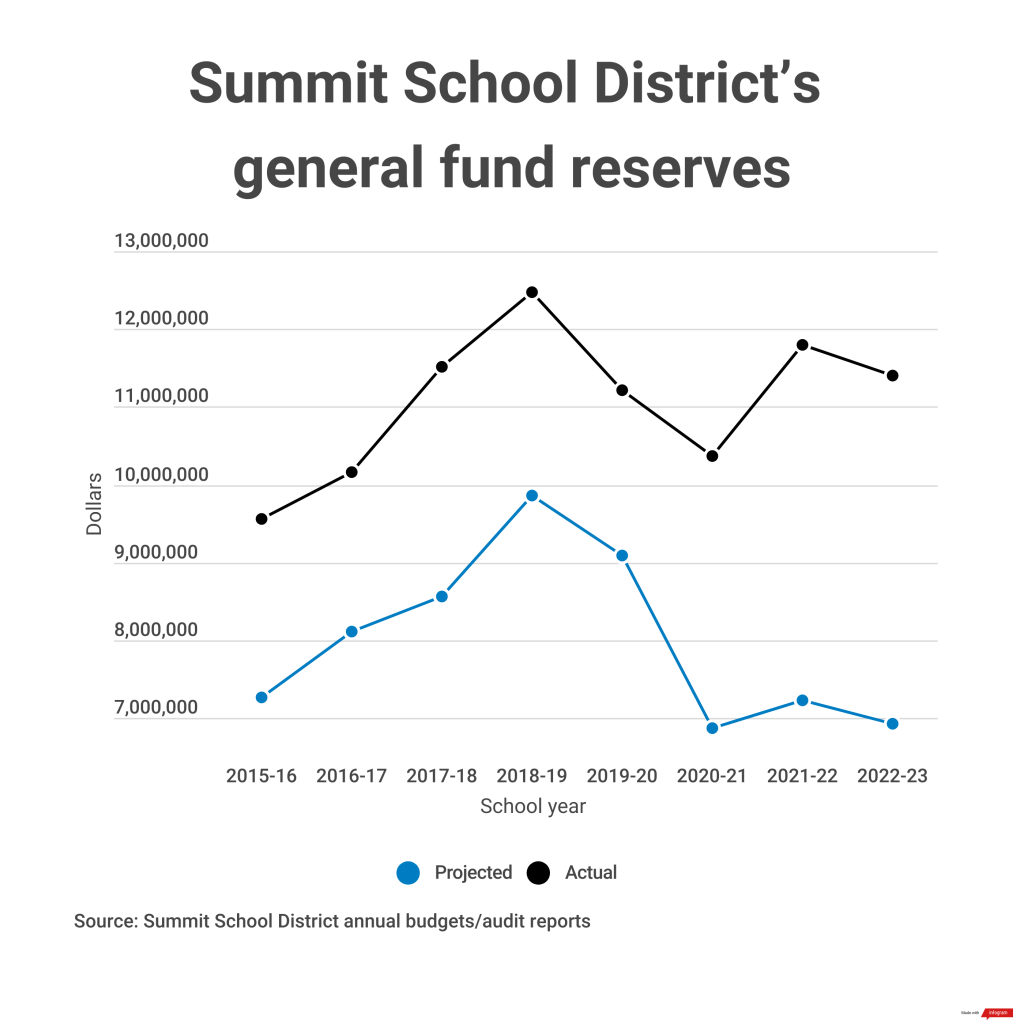
In written responses to questions from the Summit Daily News, district communications director Kerstin Anderson stated the discrepancies between projected general fund balances and those reported in audits is due to “unforeseen fiscal developments throughout the year.”
Those include higher-than-expected interest earnings, savings from unfilled positions and transfers to other funds, Anderson stated.
“Ultimately, we can not, and do not, want to rely on these types of savings to finance ongoing costs such as salaries,” Anderson stated. “While we have experienced years where the actual fund balances exceeded projections, it’s important to note these are not guaranteed surpluses and often result from unpredictable fiscal factors.”
More state dollars
General fund reserves are not the only source of financial padding the district has, Waddick said. Next school year, the district’s general fund is projected to increase by nearly 8% as a result of state reforms to public school funding.
During the 2024 legislative session, lawmakers made good on their yearslong promise to buy down what is known as the budget stabilization factor, a Great Recession-era mechanism that has diverted money from public schools for more than a decade. That, coupled with a boost in funding for rural school districts, means Summit schools will see around $3 million in new funding next school year.
But officials say next school year’s budget, which could include more than $56 million in spending, remains stressed amid competing priorities.
Already, roughly 88% of the district’s budget is projected to go to salaries, officials say. With general fund expenditures expected to rise by around 3% to meet pay increases, the budget calls for a 10% reduction in discretionary spending across all departments. Officials are also seeking to make good on pledges to improve translation and interpretation services for Spanish-speaking families as well as bolstering professional development opportunities for teachers.
That also comes as the district revises its general fund reserves policy, heeding the request of members of its financial committee who’ve pushed to raise district reserves from a minimum of 7% to 10%. When combined with the 3% state-mandated threshold, that raises minimum reserves to 13%.
“We recognize increases to teacher salary as a priority that aligns with our values of supporting our staff,” Anderson stated, adding that the full compensation package being proposed for teacher includes additional pay for bilingual educators, special education staff, and special service providers as well as paid parental and bereavement leave “for the first time in our history.”
A deal still to be reached
Last year, the teachers union reached a deal with district leaders that led to a nearly 12% average increase in salaries, though raises differed widely depending on tenure and experience.
Known as the salary schedule, teachers receive different pay based on their years with the district as well as the number of credit hours they complete as part of their continuing education. Under the deal struck last year, starting pay for new hires rose from from $50,000 to $52,200 while the longest-serving teachers, those who’d been with the district for 26 years and had accumulated 144 or more credits, saw pay increase from roughly $93,000 to $112,221.
“Ensuring that we can support the people who are working for our school district and who have been working for our district for a very long time, that was important,” Waddick said of the higher pay for veteran teachers, while adding, “We need to be appealing to both ends of our salary schedule.”
Many teachers still see salaries below $70,000, Waddick said, adding that the district’s current salary offer would only grow starting pay to $53,300. In a union statement shared by Waddick, union members say this offer comes as “our school district tells its graduates that it takes $92,600 to afford living here.”
Currently, the district has added a 5% average salary increase for all staff as a placeholder in its 2024-25 budget, which the board of education is planning to pass at its upcoming meeting on June 20. That figure may be amended, however, based on the final outcome of negotiations.
Waddick said the 5% raise will only materialize for teachers on the higher-end of the salary schedule, with most teachers seeing a raise closer to 3%.
With negotiation meetings set to resume next week, Waddick said, “I think our team is hopeful and ready to get to that table” to reach a deal that “works for us, the teachers of Summit School District, and works for our students.”






Support Local Journalism
Support Local Journalism
As a Summit Daily News reader, you make our work possible.
Summit Daily is embarking on a multiyear project to digitize its archives going back to 1989 and make them available to the public in partnership with the Colorado Historic Newspapers Collection. The full project is expected to cost about $165,000. All donations made in 2023 will go directly toward this project.
Every contribution, no matter the size, will make a difference.